
140 years of the Sonnblick Observatory: From weather tower to international centre for science and research
On 2 September 1886, the Sonnblick Observatory was opened in the Hohe Tauern. The observatory, which was built in less than a year in a truly pioneering feat and began as a simple weather observation station at a high, exposed altitude, is now much more than that. 140 years later, it ranks among the world’s highest-altitude, year-round meteorological observation stations and is an internationally significant research centre for meteorology, climate and environmental research.
‘’Our observatory on the Hoher Sonnblick has been providing continuous data on weather, climate and glaciers since 1886 – and thus offers data series that are unique worldwide at this altitude. We are grateful to have been able to conduct research of the highest standard in the fields of meteorology, the environment and climate at the Hoher Sonnblick for 140 years now, under very special conditions – largely unaffected by emissions caused by human activities,’ explains Andreas Schaffhauser, Scientific Director General of GeoSphere Austria, on the occasion of the 140th anniversary of the Sonnblick Observatory.
140 years ago, around 80 guests gathered at a location they could only reach with the greatest of effort: the summit of the 3,106-metre-high Rauriser Sonnblick in the Hohe Tauern. The occasion was the ceremonial inauguration of a weather tower, in which the weather was to be not only observed but also meticulously documented.
It was an extraordinary pioneering achievement, accomplished by the highly technically minded operator of the local gold mine, Ignaz Rojacher (1844–1891), together with his men. It was also Rojacher who suggested to Julius von Hann (1839–1921) that the summit of the Sonnblick be used for the construction of an observatory. Hann, Director of the Imperial and Royal Central Institute for Meteorology and Geomagnetism, had long recognised the need for permanent observation stations in the high mountains. The Alpine Club covered the costs of the timber-framed building, whilst the Austrian Meteorological Society took charge of financing the brick anemometer tower, the telephone line from the summit to Rauris – 25 kilometres away – and the instruments. The necessary funds were raised through collections; even Emperor Franz Joseph I contributed 500 gulden.
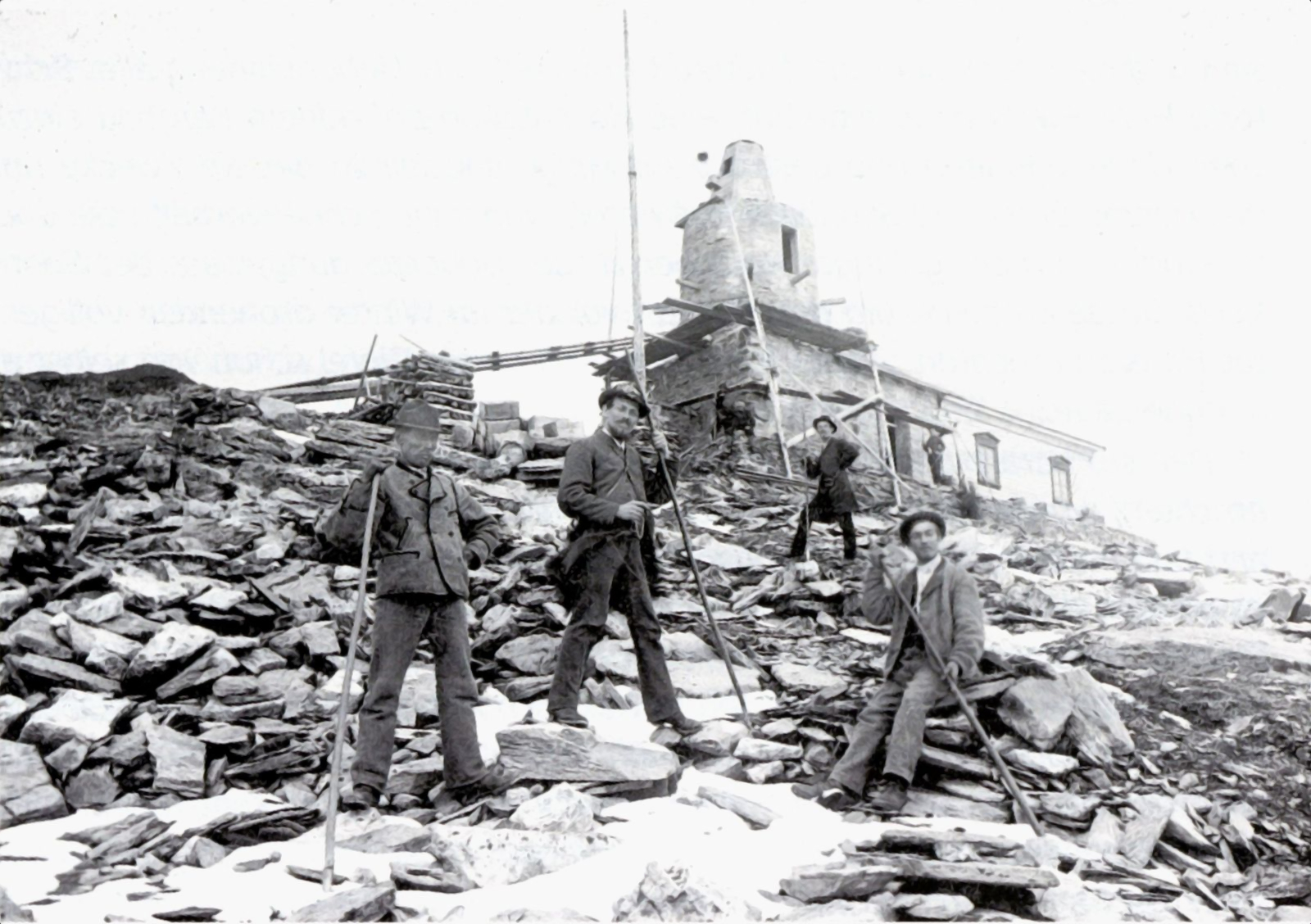
Sonnblick_1886.jpg
The high-altitude weather station, nearing completion in the summer of 1886, on the Hoher Sonnblick at 3,106 metres. © Sonnblickverein.
The Sonnblick Observatory, where GeoSphere Austria operates highly sensitive measuring instruments, is a very special place, emphasises Elke Ludewig, Director of Meteorology and Regional Offices: ‘In recent years, we have strengthened the international networking of this research site and established a European Centre for Cloud Comparison Measurements and Standardisation as part of the European research infrastructure ACTRIS. At present, around 25 scientific institutions are active here at Sonnblick.’ Elke Ludewig is proud that ‘since 1886, we have been able to carry out research projects and provide measurement results in collaboration with our national and international partners – and all this far away from human sources of emissions’.
The Sonnblick Observatory’s extensive measurement programme is funded by various institutions. The key long-term monitoring projects are primarily supported by the Federal Environment Agency (UBA), the University of Natural Resources and Life Sciences, Vienna (BOKU) and the Vienna University of Technology (TU Wien); as well as by the Federal Ministry for Women, Science and Research (BMFWF), the Federal Ministry of Agriculture, Forestry, Climate and Environmental Protection, Regions and Water Management (BMLUK), and the provinces of Carinthia and Salzburg.
Over the course of its 140-year history, the Sonnblick Observatory has weathered turbulent and, at times, difficult periods. This was particularly the case when people in the valley were also struggling and food was in short supply. Nevertheless, the research station has been staffed almost without interruption since its inception. ‘There was just one gap of three days following the end of the First World War. The observer had quite simply run out of food,’ explains Schaffhauser.
Financial worries also shaped the day-to-day lives of the operators for many years. The observatory even came dangerously close to closure. The Sonnblick Association, founded in 1892, constantly strove to raise donations and organise state support. The observatory was continuously developed.
At the start of the 21st century, the first effects of climate change also became apparent on the Hoher Sonnblick. Thawing permafrost and the associated erosion threatened the infrastructure. The observatory and the neighbouring Zittelhaus faced new challenges. Between 2003 and 2005, a summit renovation was finally carried out: 39 prestressed permanent anchors were drilled up to ten metres into the solid rock and secured, whilst crevices and cracks were filled with ‘concrete seals’.
Particularly in times of climate change, the unique long-term measurements at the Hoher Sonnblick are of special value. They reveal changes across generations and lay important scientific foundations for the future.
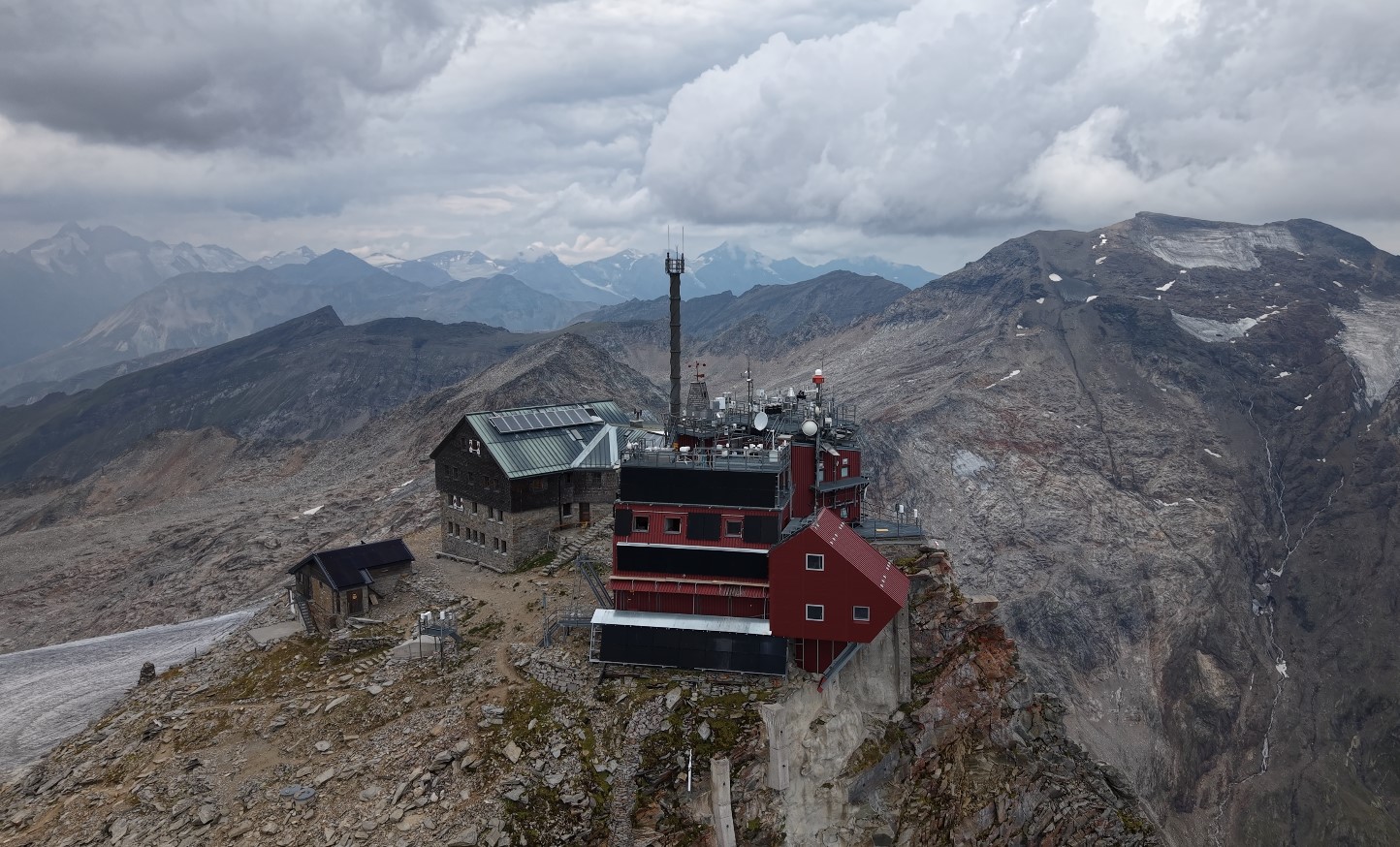
Sonnblick_2026.jpg
A bird’s-eye view of the Sonnblick Observatory (right) and the Zittelhaus (left). © GeoSphere Austria/Frießenbichler.
Translated with DeepL.com (free version)