
Alpine climate: Summary of the summer half-year 2025
The German Weather Service, MeteoSchweiz and GeoSphere Austria publish a joint assessment twice a year on the current climate in the Alpine region and its classification in terms of long-term trends. The report for the summer half-year 2025 has just been published.
The summer half-year 2025 (May to October) in the Alps was characterised by heat waves in June and August, several days with very high zero degrees Celsius temperatures, and very contrasting precipitation amounts from month to month. This is reported by the German Weather Service (DWD), GeoSphere Austria and the Federal Office of Meteorology and Climatology MeteoSwiss in the seventh edition of their joint publication series ‘Alpine Climate - Climate Conditions in the Central and Eastern Alps’.
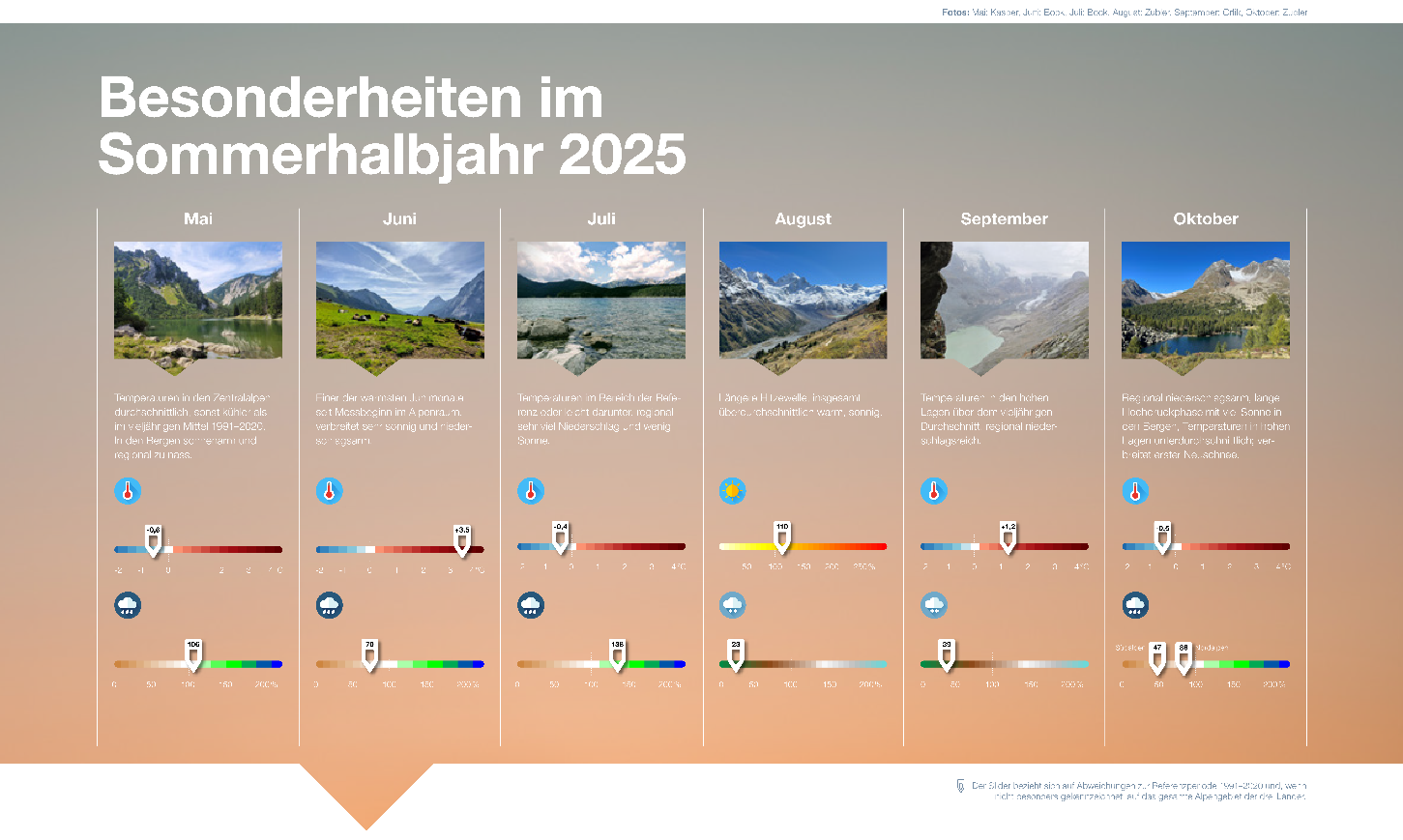
Alpenklima_Sommerhalbjahr25_Besonderheiten.png
Alpine climate: Special features in the summer half-year of 2025. © DWD/MeteoSwiss/GeoSphere Austria.
A generally cool May was followed by an extremely hot June. Between mid-July and early August, the heat took a break before returning in mid-August.
Averaged across the Alpine region of the three countries, the summer half-year was 0.7 to 0.8 °C warmer than the 1991-2020 climate average. Both at low and high altitudes, this is the fourth summer half-year in a row that has been too warm compared to the long-term average.
The hot June led to a very low number of frost days (days with a minimum temperature below 0 °C) in the high Alps. On the Zugspitze (Germany, 2,956 m above sea level) and the Sonnblick (Austria, 3,109 m above sea level), there were 70-80% fewer frost days than the long-term average. However, over the entire summer half-year, the number of frost days in the high mountains was relatively close to the average values for the reference period 1991–2020.
Days with a maximum temperature of 25 °C or higher (summer days) were above average throughout the Alpine region of the three countries. Between 500 and 1,000 metres above sea level, there were on average 25-30% more summer days in the Central Alps than the average for the reference period 1991-2020. At altitudes of 1,000 to 1,500 metres above sea level, 25 summer days were recorded, almost twice as many as in an average summer half-year.
With climate change, temperatures are continuing to rise, even at high altitudes. As a result, during the summer months, the zero degree line (the altitude at which the temperature drops below 0 °C) is increasingly climbing above 4,000 metres above sea level, reaching the highest Alpine peaks. In the summer of 1995, a zero degree line above 5,000 metres above sea level was measured for the first time at the Payerne weather station (CH). Since 2022, this has occurred one to four times every year. The highest zero degree line was recorded on 25 July 2022 at 5,184 m. This year, the zero degree line reached a new monthly record of 5,125 m in June.
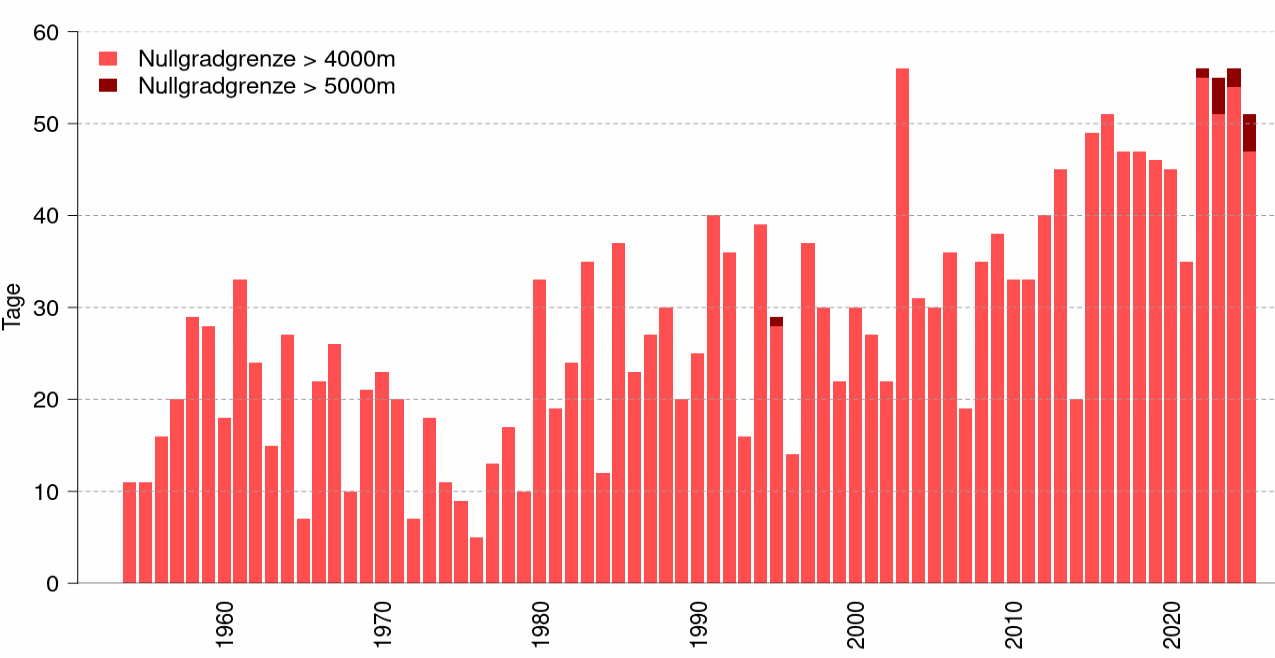
Alpenklima_Sommerhalbjahr25_Nullgradgrenze.png
Zero degree line rises: Number of days per summer (June to September, the period with the most zero degree lines above 4000 metres) with maximum height of the zero degree line above 4000 (light red) and 5000 metres above sea level (dark red), derived from radiosondes in Payerne (CH). © DWD/MeteoSwiss/GeoSphere Austria.
If the zero degree line continues to rise in summer due to climate change, this will have an impact on various areas. These include water supply, tourism, fauna and flora.
In Switzerland, the zero degree line has risen by 400 to 500 metres since the pre-industrial reference period of 1871-1900, depending on the season, and is now at about the same altitude as the Jungfraujoch (CH 3,467 metres above sea level) in summer. Depending on the extent of climate change, the zero degree line will continue to rise significantly in the future. In a world that is 3 °C warmer than the pre-industrial reference period, the average zero degree line in summer would exceed most Alpine peaks.
Precipitation levels over the entire summer half-year of 2025 were average in many regions of the Central and Eastern Alps. However, there were significant differences between individual months, with June and July showing the most striking contrasts and setting new local records.
June saw low rainfall across most of the country, and the number of days with precipitation (days with at least 1 mm of rainfall) was also low. The Zugspitze even set a new negative record: with eight days of precipitation in June compared to the average of 17, it was particularly dry.
In contrast, many stations recorded above-average numbers of precipitation days in July, with Zell am See even setting a new record with 25 days.
The Alpine region is more severely affected by the consequences of the man-made greenhouse effect than other regions or natural areas. The effects of climate change are clearly visible in this highly sensitive region. This makes information and analyses on the climate in this unique ecosystem all the more important. With their joint publication series ‘Alpine Climate – Climate Status in the Central and Eastern Alps’, the DWD, GeoSphere Austria and the Federal Office of Meteorology and Climatology MeteoSwiss provide cross-border information on the climate status of the Alps. Climate development in the individual countries is thus placed in a larger context and closely monitored in order to better protect this valuable natural, living and economic space from the effects of climate change.
Translated with DeepL.com (free version)