
One of the ten warmest years in recorded history
According to GeoSphere Austria's preliminary climate assessment, 2025 will be the eighth warmest year in Austria's recorded history in the lowlands and the second warmest in the mountains. Furthermore, 2025 will be one of the 20 driest years since records began.
2025 also confirms the trend towards an increasingly warmer climate. "Taking into account the forecasts for the last days of the year, 2025 ranks eighth in the list of warmest years in Austria's lowlands in the 258-year history of measurements, and may even make it to seventh place. In the mountains, it is set to be the second warmest year in the 175-year mountain measurement series," says climatologist Alexander Orlik from GeoSphere Austria.
In the preliminary annual balance sheet, 2025 is 0.8 °C above an average year in the recent past (climate period 1991-2020) in the lowlands of Austria and 1.3 °C above average in the mountains.
Compared to the climate period from 1961 to 1990, which was not yet so severely affected by global warming, the year 2025 will be 2.1 °C above average in the lowlands of Austria and 2.4 °C above average in the mountains.
Compared to the average for the pre-industrial period (1850–1900), temperatures in the lowlands of Austria will be 2.8 °C warmer in 2025.
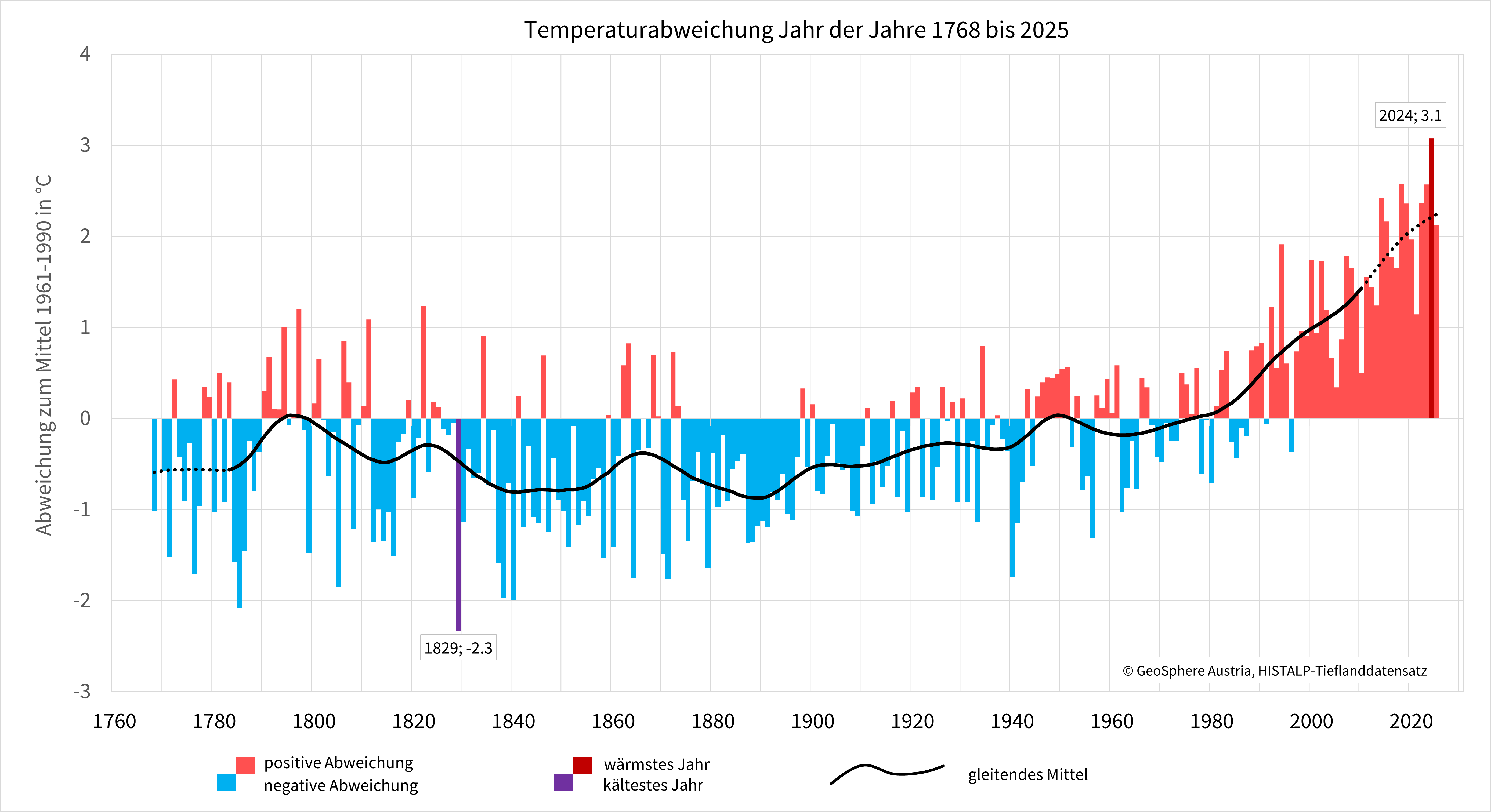
Temperature_comparison_Year_of_years_1768_2025.png
Almost exclusively extremely warm years since the 1990s: The graph shows above-average warm (red) and cold (blue) years since 1768 compared to the climate reference period 1961-1990, based on GeoSphere Austria HISTALP data for lowlands. The smoothed trend line is shown in black. © GeoSphere Austria.
Almost all of the 25 warmest years in recorded history are from the recent past:
Top 25 in Austria's lowland measurement series, which has been in existence since 1768: 2024, 2023, 2018, 2014, 2022, 2019, 2015, 2025, 2020, 1994, 2007, 2016, 2000, 2002, 2008, 2017, 2011, 2012, 2009, 1822, 2013, 1992, 1797, 2003, 2021.
Top 25 in Austria's summit measurement series, which has been in existence since 1851: 2024, 2025, 2022, 2020, 2023, 2015, 2018, 2011, 2014, 2019, 1994, 2000, 2002, 2016, 1989, 2007, 2017, 2006, 2003, 1992, 2012, 2008, 1990, 2021, 1997.
In the regional analysis, 2025 is even one of the three warmest years in recorded history in some low-lying areas. For example, in the preliminary analysis, 2025 is the second warmest year in Klagenfurt, Millstatt, Obergurgl and St. Andrä/Lavanttal, and the third warmest in Lienz and Obervellach.
2025 was very dry throughout the year. On average across Austria as a whole, there was 13 per cent less precipitation in 2025 than in an average year in the recent past (climate average 1991-2020). This makes 2025 one of the 20 driest years in the precipitation measurement series, which dates back to 1858.
According to preliminary estimates, the number of hours of sunshine is in line with the long-term average (+2 per cent).
Translated with DeepL.com (free version)