
Cooling with geothermal energy
Geothermal energy can also be used for cooling in an efficient, climate-friendly and cost-effective manner.
Heat stress in Austria is increasing, and with it the cooling requirements for buildings. Near-surface geothermal energy using geothermal probes or thermal groundwater systems offers a sustainable and energy-efficient solution for cooling in summer.
‘Most people know geothermal energy as a heating solution for winter. But exactly the same systems can also be used for cooling in summer – efficiently, climate-friendly and cost-effectively,’ explains Cornelia Steiner, geothermal energy expert at GeoSphere Austria. Excess heat is extracted from the building and transferred to the comparatively cooler subsoil. In summer, only the circulation pump does the work in what is known as free cooling, while the heat pump itself remains switched off. The system operates quietly, requires no additional refrigeration machines and reduces energy consumption to a minimum compared to conventional air conditioning systems. This form of passive cooling works particularly well in combination with surface heating systems such as floor or ceiling cooling (keyword: component activation).
Another advantage is that the heat released into the ground during cooling can be reused in winter. This means that the ground starts the heating season slightly warmer locally, which increases the efficiency of the heat pump. However, this requires that the system is also used for heating in winter, as this is the only way to extract the stored heat and avoid one-sided warming of the ground.
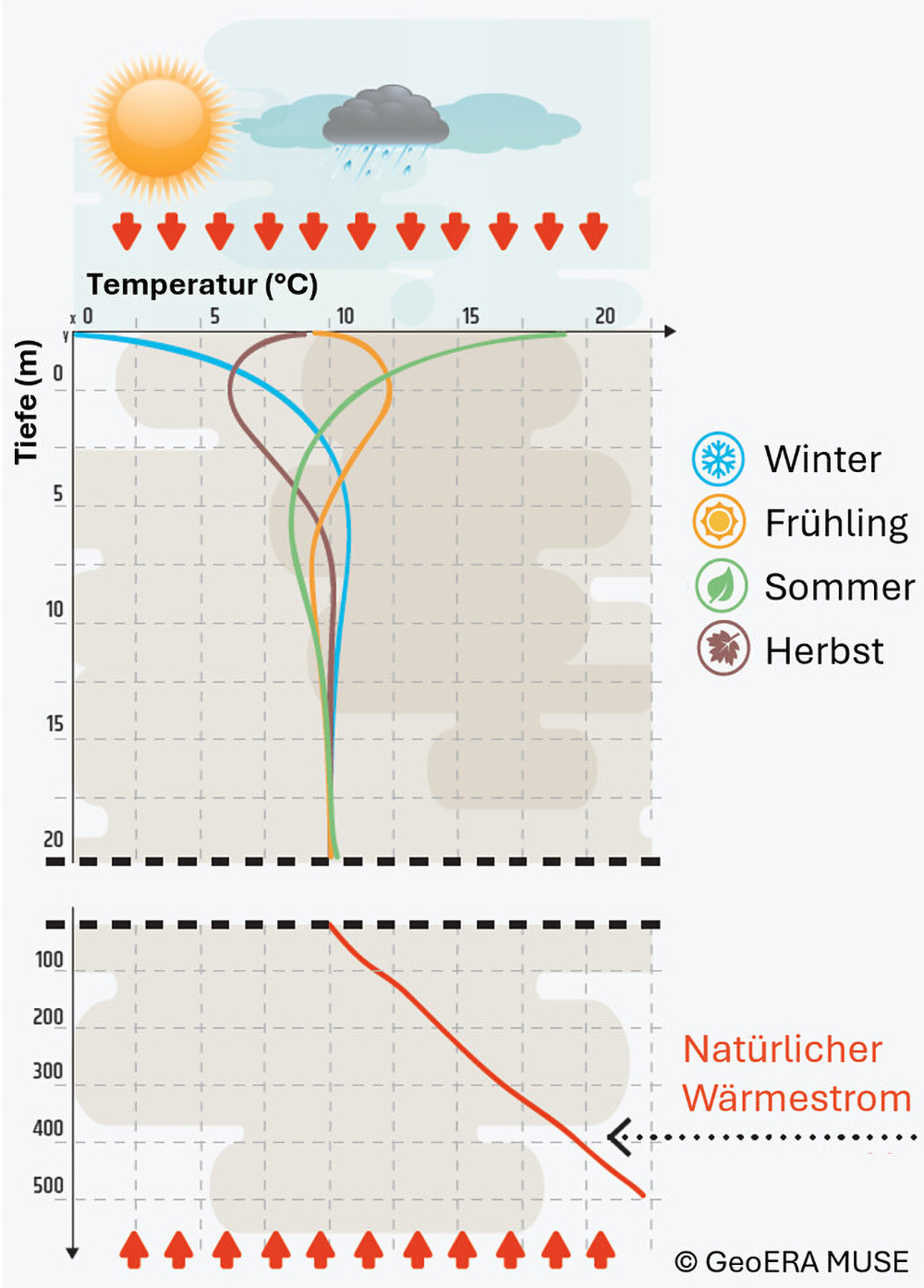
The summer warming of the earth's surface penetrates the ground only slowly and in a highly attenuated form. Even at a depth of just a few centimetres, daily temperature fluctuations disappear, and at a depth of approx. 15 metres, only seasonal temperature fluctuations of +/- 2 °C are visible. From a depth of around 15 to 20 metres, the temperature remains almost constant throughout the year, roughly corresponding to the average annual air temperature. At even greater depths, the temperature then rises gradually due to natural heat flow. However, groundwater shows that this temperature regime is not completely immune to change. In Vienna, for example, the temperature of groundwater near the surface rose by 1.4 degrees between 2011 and 2020.
Cooling_with_geothermal_energy.jpg
Jahreszeitliche Temperaturprofile im Untergrund: Die starken Schwankungen der Temperatur an der Erdoberfläche dringen nur langsam und stark gedämpft in den Untergrund vor. Ab rund 15 bis 20 Metern Tiefe herrscht das ganze Jahr über eine nahezu konstante Temperatur, die ungefähr der mittleren Jahrestemperatur der Luft entspricht. © GeoERA MUSE.
The main reason for the warming of groundwater is the rise in air temperature: the number of hot days (at least 30 degrees) has multiplied in Austria in recent decades. Between 1961 and 1990, there were between 3 and 12 hot days per year in Austria's provincial capitals, with the records mostly standing at 20 hot days per year. Between 1991 and 2020, there were already between 9 and 23 hot days per year on average in the provincial capitals, with most records exceeding 40 hot days. The currently extreme value of 40 hot days per year in Austria will become the norm by 2100 if global greenhouse gas emissions continue unabated. The records will then be in the currently unimaginable range of 60 to 80 hot days per year. If the Paris climate target is met, the number of hot days in Austria could stabilise at just above the current level. The demand for cooling will therefore continue to rise in the coming years.
GeoSphere Austria's research and data processing provide important foundations for the optimal use of geothermal energy as a renewable energy source for heating and cooling. The freely available online Geothermal Energy Atlas (->Geothermal Energy Atlas) provides information on the possibilities of thermal utilisation of groundwater and geothermal probes, for example. This allows geothermal-relevant geodata to be displayed both across large areas and for specific locations, and it is also possible to calculate the heating and cooling potential at property level. The application is aimed at private individuals and planning offices for an initial assessment of energy potential and provides comprehensive and low-threshold access to planning data. The Austria-wide Geothermal Atlas is being continuously expanded. Detailed information is already available for Vienna and will soon be available for Lower Austria.
Translated with DeepL.com (free version)