
Earthquakes in February 2026
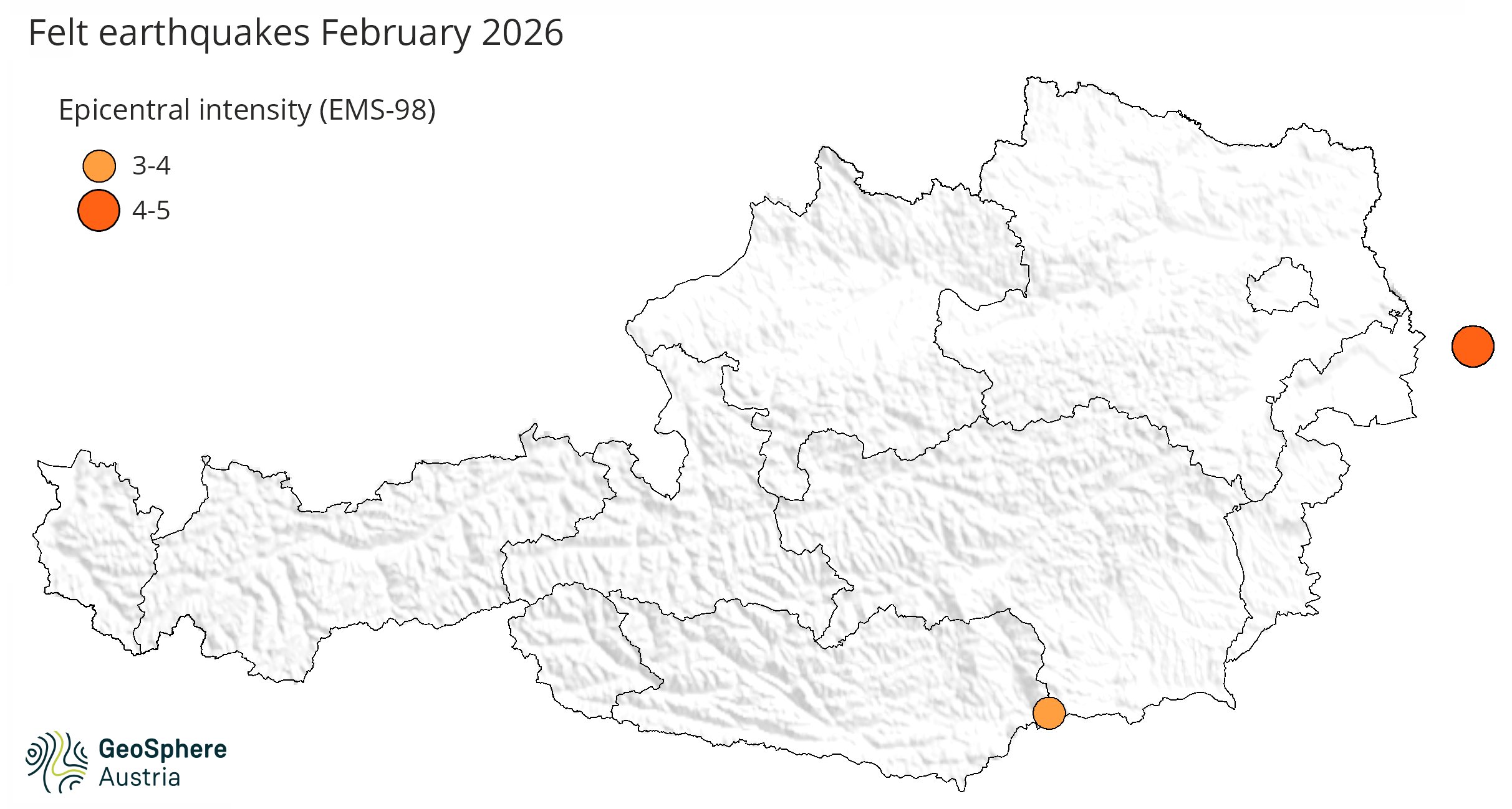
In February, two earthquakes were felt by the population in Austria – one in the border region between Carinthia and Styria and a relatively strong earthquake located in Slovakia.
On February 21 at 1:44 p.m. CET, a strong earthquake measuring 4.4 on the Richter scale struck Slovakia, with its epicenter approximately 30 km southeast of Bratislava (47.96°N, 17.42°E) near the Hungarian border. The tremors were felt strongly in Slovakia and numerous buildings were slightly damaged. In Austria, the earthquake was felt by many people in several provinces. The earthquake service received around 300 reports from the population. The tremors were felt clearly in places near the border with Slovakia and Hungary, and in a few cases strongly. Isolated cases of very minor damage, such as hairline cracks, were reported. In Vienna, the quake was only weak and mainly felt on higher floors, as was the case in Eisenstadt, St. Pölten, Krems, and the Wiener Neustadt area, as well as in some localities in the Most-, Wald-, and Weinviertel regions, in southern Burgenland, and in eastern Styria. The intensity reached a maximum of 4 to 5 on the 12-level European Macroseismic Scale (EMS-98) in Austria.
A few kilometers northeast of Lavamünd, Carinthia (46.66°N, 15.04°E) was the epicenter of a magnitude 2.4 earthquake that occurred on February 24 at 7:07 p.m. It was felt weakly to distinctly in several places in southern Styria as far as Kitzeck and Heimschuh, with reports of distinct shaking and rumbling. The intensity was 3 to 4 on the EMS-98.
Earthquakes_February_2026.png
Epicenters and intensities of the earthquakes felt in Austria in February 2026. For the earthquake in Slovakia, the maximum intensity in Austria is given in the map. © GeoSphere Austria.
Excerpt from the short form of the 12-level European Macroseismic Scale 1998, based on Mercalli-Sieberg.
- Degree 3 – Weak: The earthquake is felt indoors by a few. People at rest feel a swaying or light trembling. Hanging objects swing slightly.
- Degree 4 – Largely observed: The earthquake is felt indoors by many and felt outdoors only by very few. A few people are awakened, the vibration is moderate, slight trembling of the building or room. Glasses, windows and doors rattle, light furniture shakes visibly.
- Degree 5 – Strongly observed: Perceived indoors by most people, outdoors by some. Many people wake up. Some people are frightened. Buildings are shaken as a whole. Hanging objects sway strongly. Small objects are displaced. Doors and windows swing open or shut. Hairline cracks appear on a few buildings, especially those prone to damage.
UTC (Universal Time Coordinated) = GMT (Greenwich Mean Time) Data for worldwide earthquakes according to U.S. Geological Survey M: Magnitude (logarithmic energy scale) Information provided without guarantee
Seismological Service of Austria - GeoSphere Austria Hohe Warte 38, A-1190 Vienna Tel. +43 1 36026 2508 E-Mail: seismo@geosphere.at