
Environmentally friendly energy generation using disused oil wells
The Weinviertel region is often referred to as the ‘Texas of Austria’. Oil and natural gas have been extracted there for around a century. Over time, more than 4,000 wells have been drilled to the east and north-east of Vienna. However, many of these will soon no longer be used by the hydrocarbon industry as production continues to decline. The TRANSGEO project, in which GeoSphere Austria played a key role, now sees an opportunity for the sustainable use of these wells – the keyword being geothermal energy.
The Interreg Central Europe project TRANSGEO (Transforming Abandoned Wells for Geothermal Energy Production) covers five countries: Germany, Hungary, Slovenia, Croatia and Austria. To put it more precisely: the search focused on suitable sedimentary basins with a history of oil and gas production. These included, for example, the Pannonian Basin, the Molasse Basin and the North German Basin. Feasibility studies were carried out in a total of eight ‘test regions’ over a period of three years. The results were discussed at a final conference held from 14 to 16 April at the Vienna University of Economics and Business.
According to geologist Monika Hölzel from GeoSphere Austria, around 100 boreholes in the Weinviertel region are suitable for geothermal use once production has ceased: ‘The nature of the geological subsurface and the heat output vary depending on the location and depth.’ The aim is to repurpose the boreholes. These can then be used either as deep borehole heat exchangers (DBHE), as aquifer thermal energy storage (ATES), as borehole thermal energy storage (BTES), to utilise the hot water for heating or electricity generation (hydrothermal geothermal energy), or to utilise water injected at depth and thus heated (EGS – Enhanced Geothermal Systems).
Deep drilling has a tradition stretching back decades in the Weinviertel region. On 31 May 1983, the ‘Zistersdorf Übertief2a’ borehole was completed – at 8,566 metres, it is the deepest borehole in Austria. On average, the approximately 4,000 boreholes in the Weinviertel are 1,500 metres deep. However, the radius and condition of a borehole are also crucial for geothermal use. Geologist Hölzel: ‘The diameter should not be less than seven inches (just under 18 centimetres, note). That is the technical limit for pipes in which heat or water circulates.’
What’s more: the distance to potential consumers must not be too great due to heat loss. This is a particular disadvantage in the Weinviertel, where the population density is not particularly high. ‘For Austria, deep geothermal probes have emerged as the most promising technology. The conversion costs depend on depth and materials and range between 300,000 and 500,000 euros. However, this saves on drilling costs, which run into the millions,’ explains Monika Hölzel. There is political interest, the geologist emphasised. During a meeting with the project team in February 2026, legal and economic hurdles were discussed with MEP Anna Stürgkh (Neos).
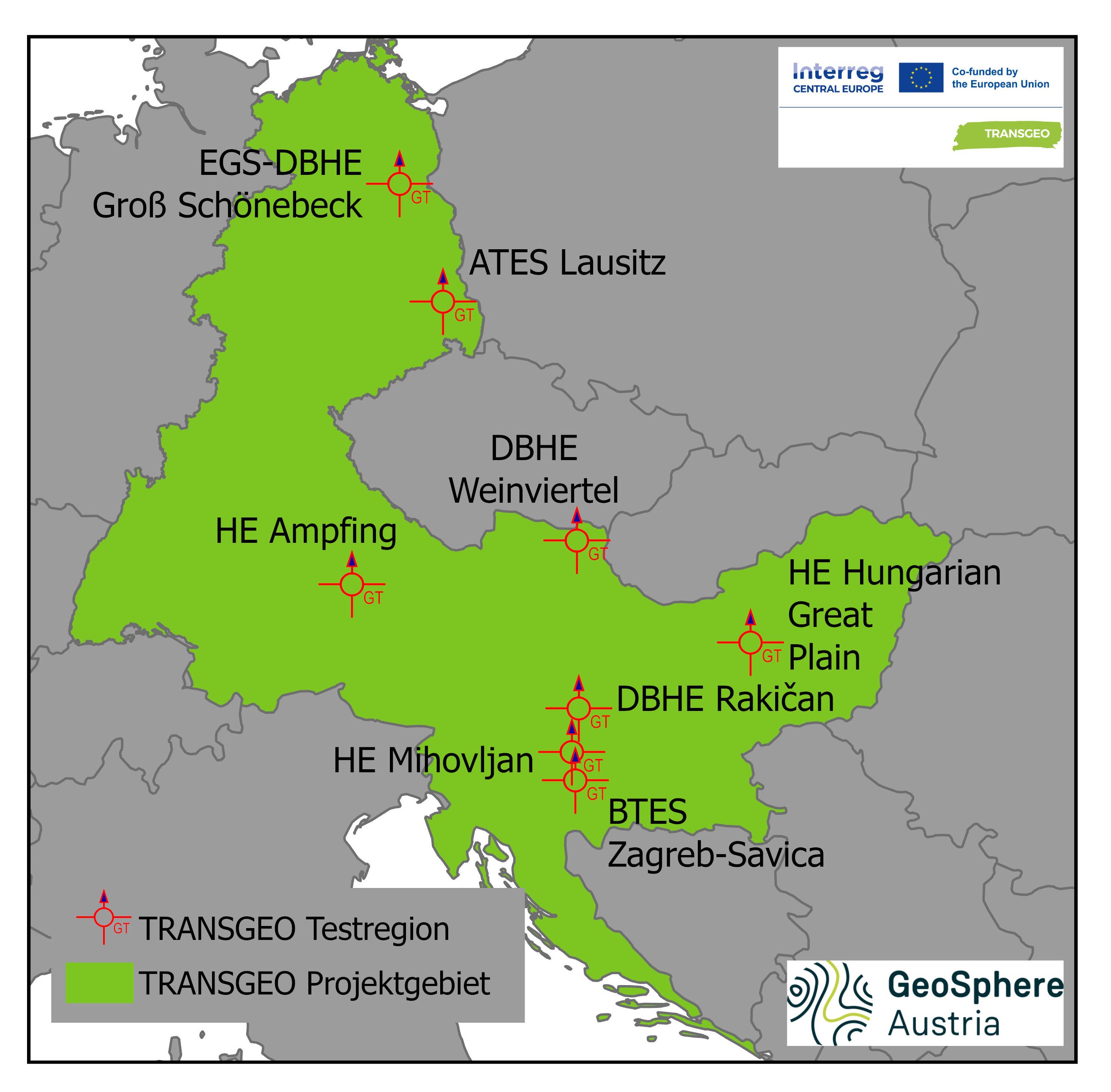
Transgeo_GeoSphere_testregions.jpg
Overview of the project area and the test regions of the Transgeo project. © GeoSphere Austria.
Translated with DeepL.com (free version)