
GeoSphere Austria: 49 felt earthquakes in Austria so far this year
On Friday, 9 October 2026, at 06.46, an earthquake measuring 3.1 on the Richter scale struck near Sistrans, south-east of Innsbruck. It was the 28th felt tremor in Tyrol in 2026. According to experts at GeoSphere Austria’s earthquake service, this represents a temporary increase in activity which, whilst unusual, has occurred several times before in the region. The quakes reached magnitudes of up to 3.8 and were felt by many people, in some cases quite distinctly. However, no damage to buildings has been reported so far, nor is any expected given this magnitude.
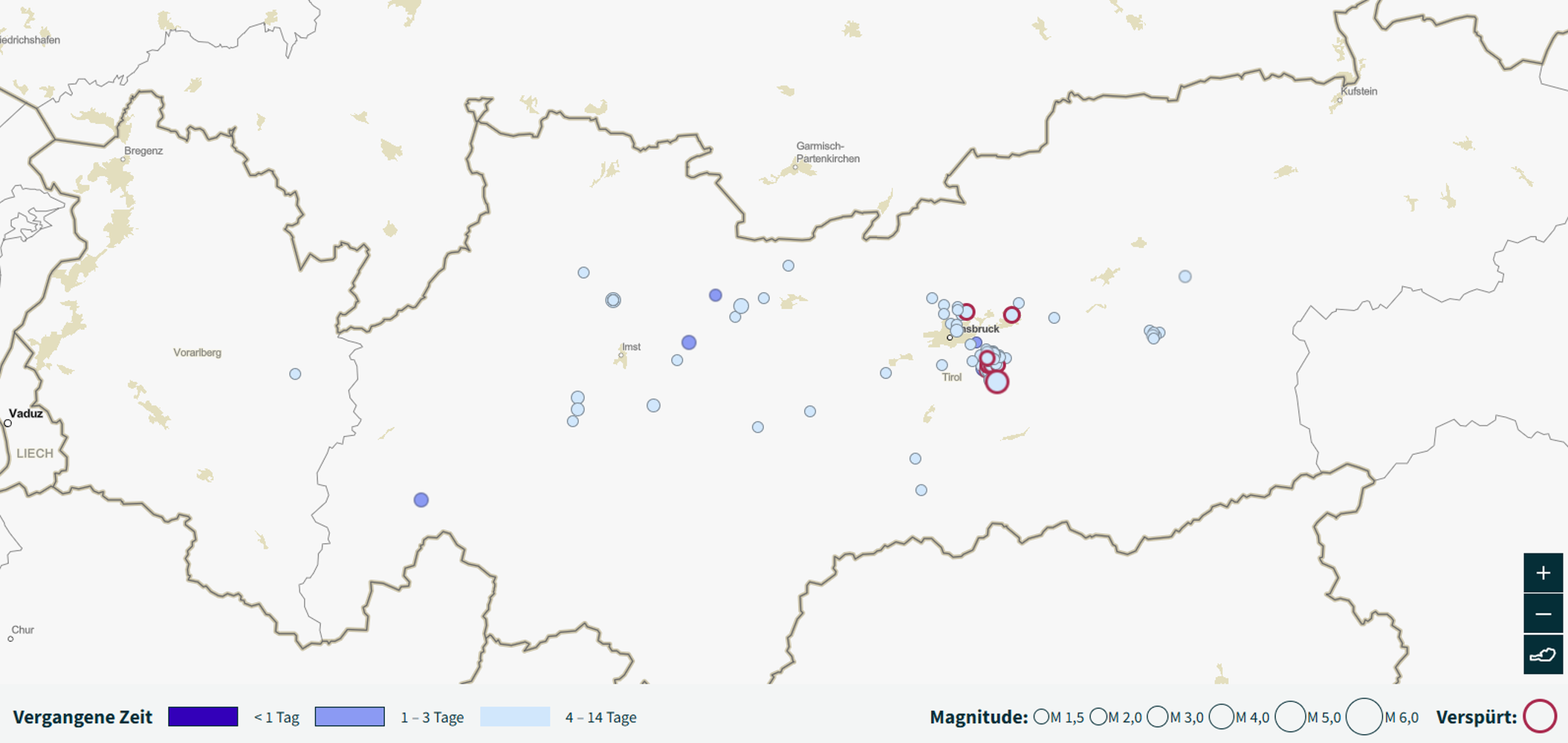
‘Since the beginning of August, we have recorded increased seismic activity in the Innsbruck–Hall area. During this period, more than 270 earthquakes occurred, 28 of which were felt,’ explains Maria Papí-Isaba, head of the GeoSphere Austria Seismic Service. ‘The activity is currently concentrated in three areas: east of Hall, south-east of Innsbruck and north of Innsbruck.’ Whilst such a cluster of felt events is not an everyday occurrence, it does happen from time to time in Tyrol at irregular intervals, as was most recently the case with the series in Waidring in 2024. In total, the Seismic Service has recorded 1,163 earthquakes in Austria so far in 2026 (49 of which were felt), 708 of them in Tyrol alone.
Earthquake_series_Tyrol.png
Recent series of earthquakes in the Innsbruck/Hall area in Tyrol (period: 25 September to 9 October 2026). © GeoShere Austria.
Papí-Isaba emphasises that what we are dealing with in Tyrol is a ‘tectonic fault zone’. ‘It is a zone of weakness in the Earth’s crust. The tectonic plates are trying to slide past one another; the stresses in the subsurface become too high for the rock, which can no longer withstand them, leading to a rupture that we feel as an earthquake,’ says the seismologist. Tyrol is generally regarded as the federal state with the highest level of seismic activity. The strongest event so far in the current phase of seismic activity in Tyrol, south-east of Innsbruck, occurred on 26 September and had a magnitude of 3.8 – followed by the event on 7 October, which measured 3.7.
There are several other fault zones in Austria. These include the Mur-Mürz system in Styria, the Vienna Basin, the Eastern Alpine fault systems such as the Pustertal-Gailtal Fault, the Katschberg Fault and the Lavanttal Fault in Carinthia, and the North Alpine Thrust in north-eastern Austria. The highest magnitudes in recent years have been recorded in the Vienna Basin and the Mur-Mürz Fault. In spring 2021, two earthquakes in the Neunkirchen area reached magnitudes of 4.5 and 4.6. In February 2024, a tremor with a magnitude of 4.5 was recorded near Schottwien on the Semmering, and in March 2023, one near Ebreichsdorf with a magnitude of 4.3. The strongest earthquake of this year occurred in July near Schottwien with a magnitude of 4.4. This also caused minor damage, such as cracks in the render on house walls.
Tyrol is generally one of the most seismically active regions in Austria. Periods of increased earthquake activity occur time and again,” explains Maria Papí-Isaba. “Further earthquakes and felt aftershocks are possible. However, the timing and magnitude of future events cannot be predicted.’ There is currently no indication from the latest activity that a stronger earthquake is imminent. ‘We are continuing to monitor developments on an ongoing basis,’ assures the head of the Earthquake Service at GeoSphere Austria. Reports from the public are particularly important for assessing the impact and can be submitted via the reporting form on the GeoSphere Austria website or via the ‘QuakeWatch Austria’ app.
The strongest earthquake in Austria’s recent history occurred on 16 April 1972 in Seebenstein (Lower Austria), with a magnitude of 5.3. The effects were felt as far away as Vienna, where the fire brigade was called out to around 400 incidents. At the time, parts of the balustrade at the University of Vienna collapsed and numerous chimneys across the city were damaged. On 8 October 1927, a 5.2-magnitude earthquake in Schwadorf near Vienna caused irreparable damage to buildings. The strongest earthquake ever recorded in Austria is considered to be the one that struck on 15 September 1590 at Riederberg near Vienna. At that time, numerous church towers collapsed in Vienna, and there were also fatalities. The estimated magnitude was between 5.7 and 6.0.
Earthquake_Sistrans_09-10-2026_06-46_record.png
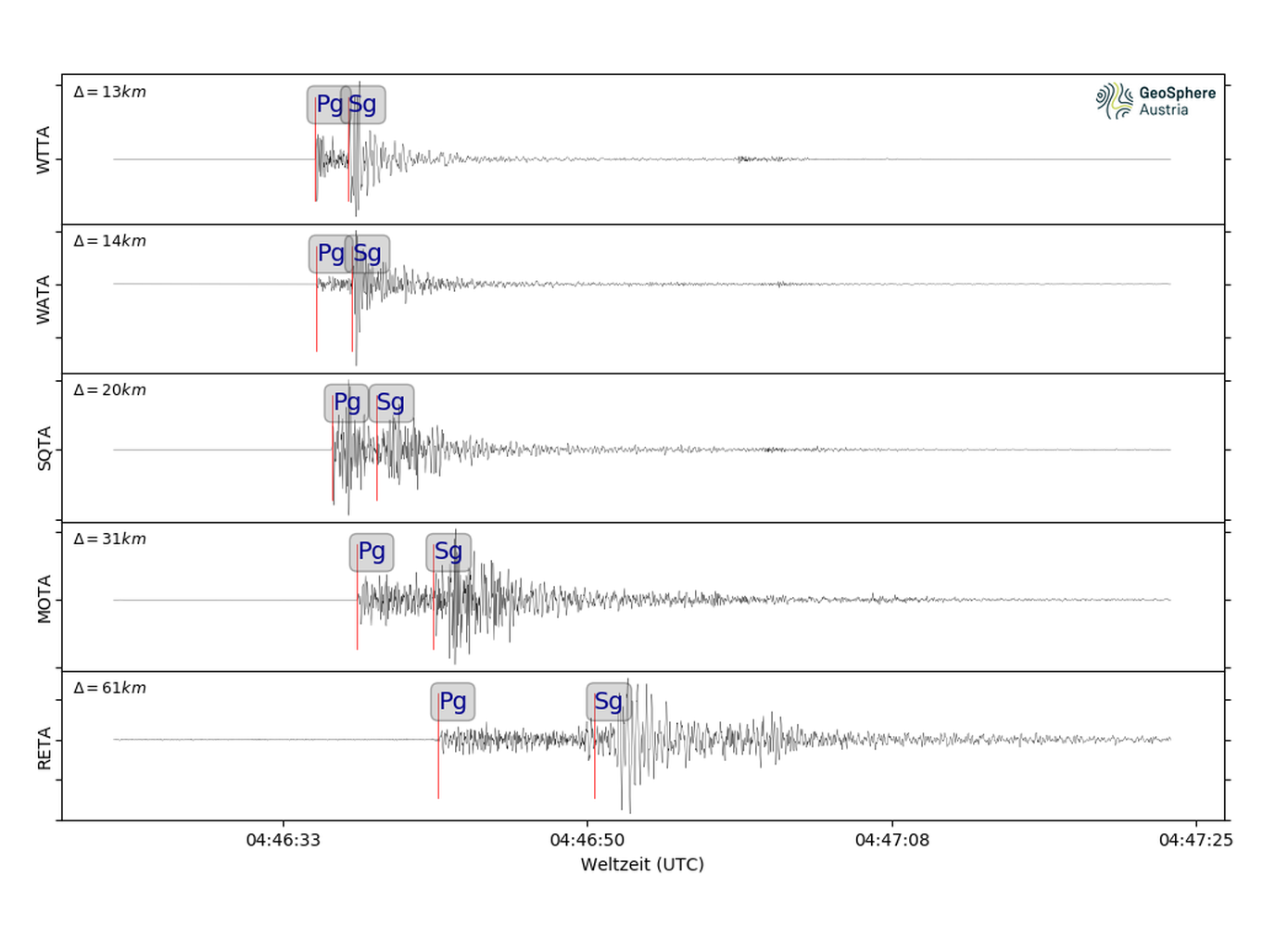
Record of the earthquake at Sistrans on 9 October 2026, with a focal time of 04:46:32 UTC (local time: 06:46:32), magnitude 3.2. © GeoShere Austria.
Translated with DeepL.com (free version)