
Geothermal Energy as an Indispensable Component of the Energy Transition
On World Geothermal Day, October 17, the spotlight is on an energy source that offers enormous potential for climate protection, security of supply, and the heating transition: geothermal energy. It harnesses the natural heat of the subsurface and provides renewable energy regardless of weather or time of day.
‘The heating transition plays a key role in the success of the energy transition. About half of all energy consumption is accounted for by the heating sector, yet only a portion of that comes from renewable sources. Geothermal energy can make a decisive contribution here,’ emphasizes Cornelia Steiner from the Department of Mineral Resources Geology and Geoenergy at GeoSphere Austria. ‘As a domestic energy source, geothermal energy reduces dependence on imported fossil fuels, strengthens energy security, and supports the transition to a climate-neutral energy supply. In a nutshell: No energy transition without a heating transition,’ explains Steiner.
A basic distinction is made between deep and near-surface geothermal energy. Deep geothermal energy harnesses the heat stored deep underground, for example by extracting thermal water from depths of up to several thousand meters. Temperatures of over 90 degrees Celsius can be reached in this process. In Austria, deep geothermal energy has so far been utilized in ten facilities, and the hottest well for deep geothermal energy is currently located in Fürstenfeld, with a temperature of 124.5 degrees Celsius. It reaches a depth of 3,188 meters.
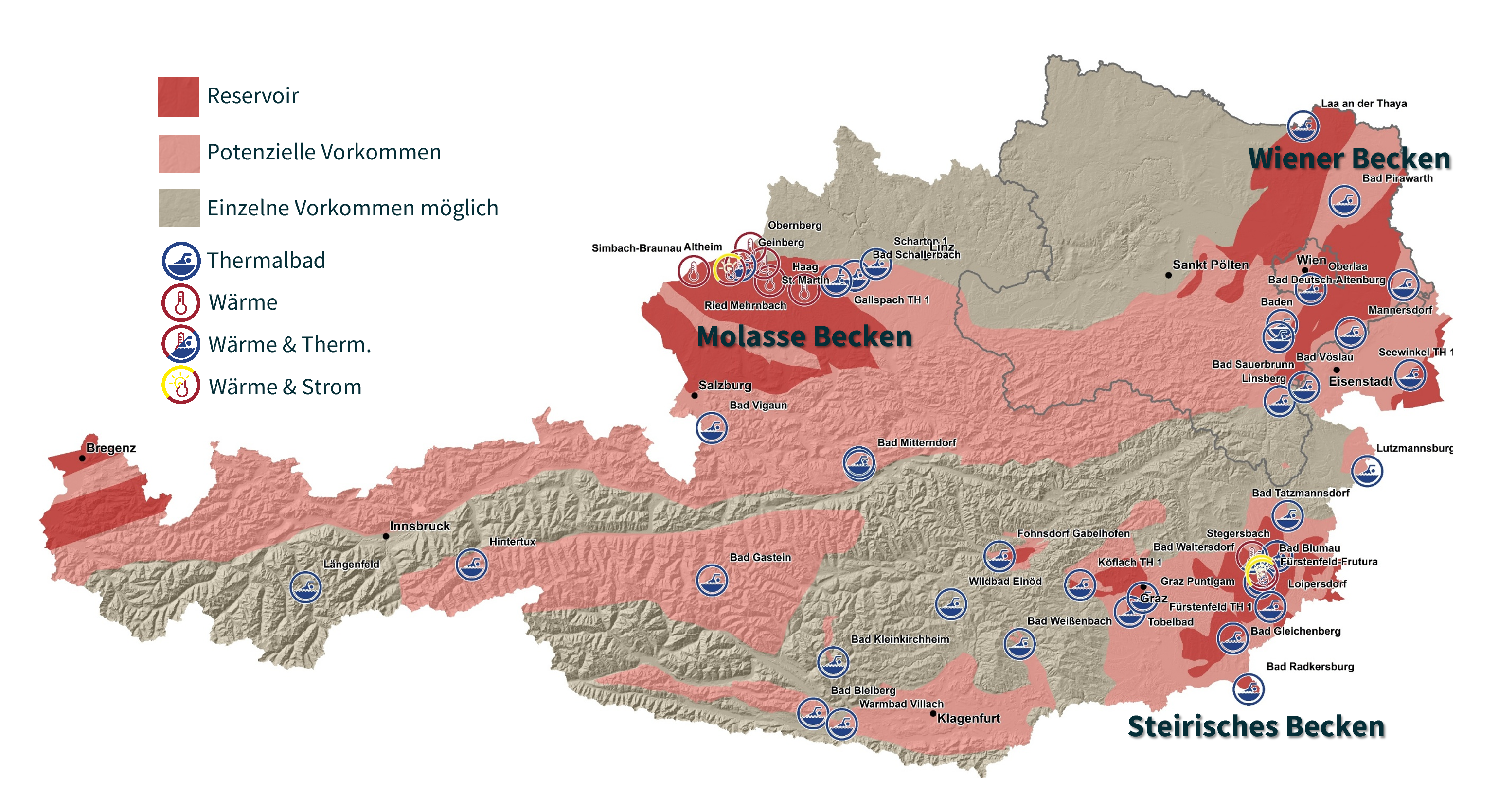
Tiefe Geothermie_AUT.png
Hydrothermal deposits and types of deep geothermal energy use in Austria. © GeoSphere Austria.
Shallow geothermal energy encompasses systems up to 300 meters deep and can be used almost everywhere. Geothermal probes, groundwater heat pumps, and horizontal and trench collectors are used. Shallow geothermal energy can be used not only to heat buildings but also to cool them. The subsurface acts as a ‘heat battery,’ serving as a natural energy storage system: heat absorbed in the summer can be reused in the winter. The majority of geothermal heat used in Austria comes from near-surface systems. According to estimates, they generate about eight times more heat than deep geothermal energy.
The use of deep geothermal energy in Austria began in 1979 with the plant in Bad Waltersdorf. Many of the first geothermal deposits were discovered during oil and gas drilling, when hot water was tapped instead of fossil fuels. While the use of thermal water was initially focused primarily on thermal and spa baths, targeted heat supply via geothermal district heating networks later gained increasing importance. Today, deep geothermal energy is used primarily for heat supply in Austria. At two locations—Fürstenfeld and Bad Blumau (both in Styria)—electricity is also generated. The combination of heat and electricity generation enables particularly efficient use and improves the economic viability of electricity production.
Shallow geothermal energy has an even longer history of development. The first applications emerged as early as the 1950s. Following an initial boom in the 1980s, the number of plants increased sharply in the 1990s and early 2000s. Expansion reached its peak to date with the global financial crisis. Since then, new plants have continued to be built, but the record numbers seen at that time have not been matched.
Translated with DeepL.com (free version)