
Mountain weather expertise online: a better overview, clearly presented
The websites of the Austrian and German Alpine Clubs (ÖAV and DAV) have always been ‘fed’ not only with mountain weather data from GeoSphere Austria, but also with detailed text content. After just over ten years, a change is now being introduced: Through more concise information and even more detailed data for tour planning, mountaineers are to be given a quicker overview of the current weather conditions in the mountains.
Mountain weather on the alpenverein.at and alpenverein.de websites has been a perennial favourite for 20 years now. However, it is not simply a matter of weather data being automatically displayed, as is the case with so many other services: ‘No, here in Innsbruck, meteorologists pore over the data every day to formulate suitable forecast texts for the mountaineering community,’ explains Manfred Bauer, head of the GeoSphere regional office for Tyrol and Vorarlberg. It all began with forecasts for the Western and Eastern Alps. More than ten years ago, these were supplemented with texts for seventeen Alpine regions – categorised according to meteorological criteria.
There is now a change here: instead of multi-line texts, there is now just a headline that summarises the weather conditions briefly and concisely. In addition, comprehensive forecast data on weather conditions in the respective region is now displayed. These have been carefully selected in cooperation with the mountaineering departments of the DAV and ÖAV. In addition to standard information on precipitation and sunshine duration, they include not only temperatures for different altitudes, but also wind gusts and the probabilities of fog or thunderstorms.
All this data is checked daily by the meteorological experts at GeoSphere Austria and revised as necessary. The advantages of the new format are not only a quicker overview of weather conditions, but also more detailed information for route planning: ‘Even though some may miss the full-length texts, we meteorologists view the changes positively. We can now not only work more efficiently, but will continue to deliver the same quality for the best mountain weather forecast,’ assures Bauer. And the good news – though not for those feeling nostalgic: the forecasts for the Western and Eastern Alps will continue to be provided in full text and, as has been the case for the past two decades, will be available to download as a PDF.
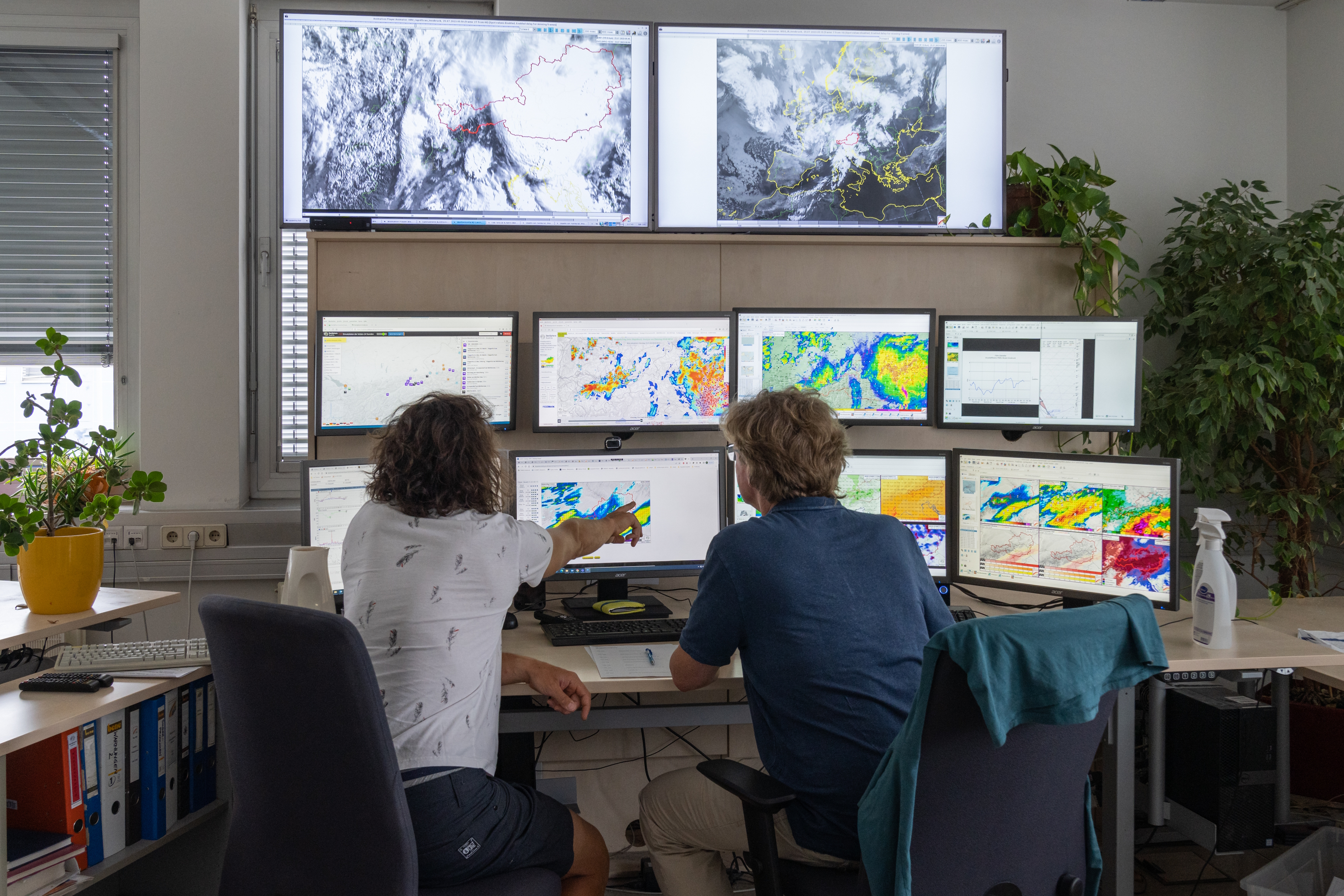
Weather forecast centre_Innsbruck.jpg
The Forecasting Centre at the Innsbruck Regional Office of GeoSphere Austria. © KSC/alpinguin.
Translated with DeepL.com (free version)