
Perfect conditions for a partial solar eclipse
On Wednesday evening, a partial solar eclipse with a maximum coverage of 89 per cent will be visible across the whole of Austria. It is likely to be the most spectacular event of its kind since the total solar eclipse on 11 August 1999.
Wednesday evening is set to be cloudless and starry across the whole of the country – perfect conditions, then, for observing a partial solar eclipse. In Vienna, the Moon will begin to pass in front of the Sun at 7.22 pm; just two minutes later, the spectacle will begin in Bregenz. At 8.14 pm in Vienna and 8.17 pm in Bregenz, the maximum coverage will be 89 per cent. This means it will be just 11 per cent short of a total solar eclipse, such as the one that will be visible in northern Siberia, Iceland, Greenland and Spain, for example.
Whilst during the total solar eclipse over Austria on 11 August 1999 the Moon moved in front of the Sun in the middle of the day, this time it will appear like ‘a gloomy sunset’, says astrophysicist Eva Weiler from the Austrian Space Weather Office at GeoSphere Austria, describing the upcoming event. Weiler nevertheless recommends wearing solar eclipse glasses and not looking directly at the Sun.
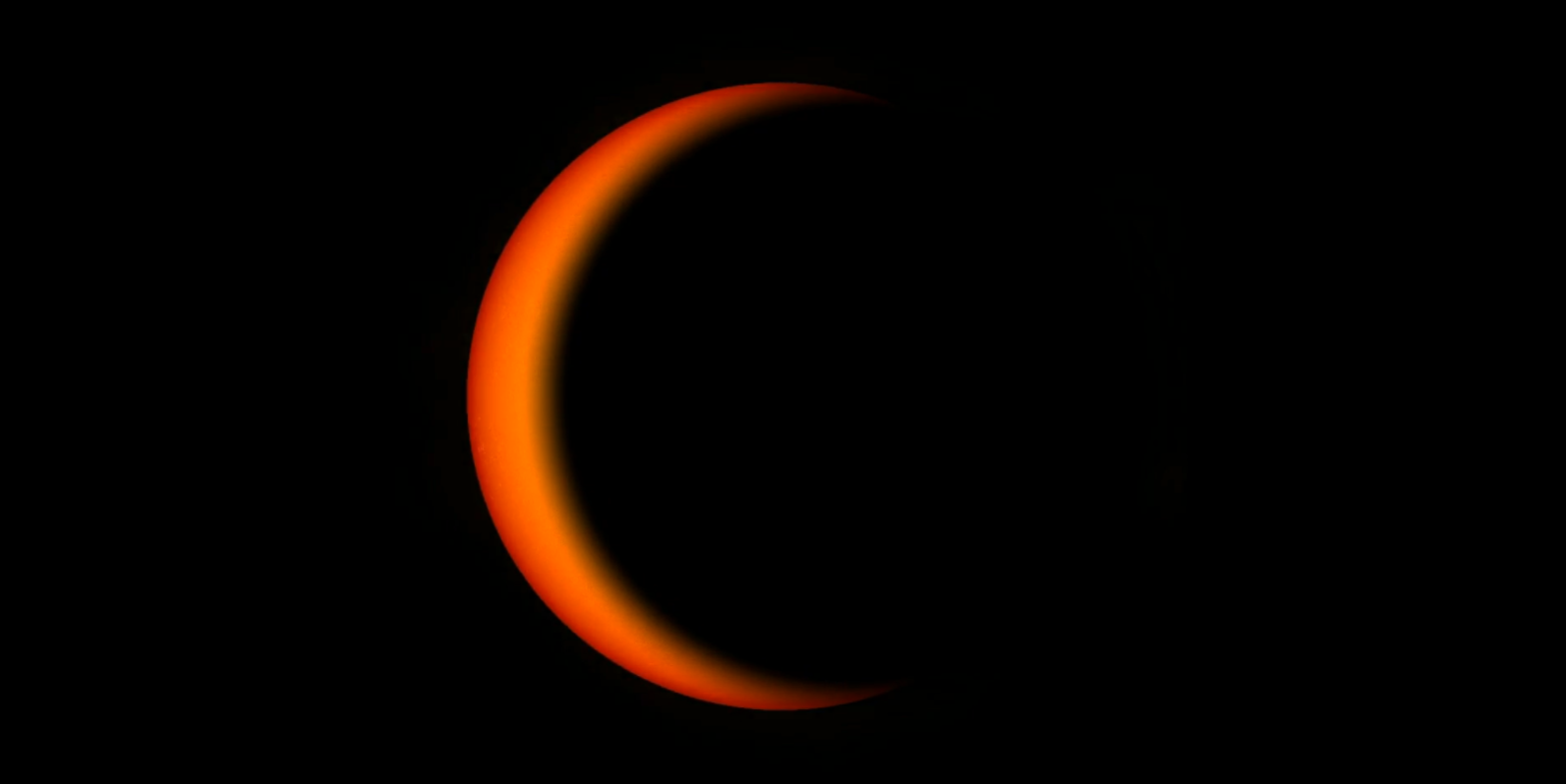
Partial-eclipse_2026.png
Illustration of a partial solar eclipse. © GeoSphere Austria/LeLouedec.
‘A solar eclipse can only be observed during a new moon, that is, when the Moon is positioned between the Earth and the Sun and obscures the Sun,’ explains Eva Weiler. Incidentally, as the Moon’s orbit is slightly tilted relative to the Earth’s orbit, a solar eclipse does not occur during every new moon, but on average only twice a year. During a total solar eclipse, the Moon covers 100 per cent of the Sun, revealing the Sun’s outermost atmospheric layer, the solar corona. Weiler says: ‘Although here in Austria we will see the Moon cover just under 90 per cent of the Sun, the visible ten per cent of the Sun is still too bright and outshines the solar corona.’ Nevertheless, the researcher is looking forward to Austria experiencing ‘a rather exciting sunset on 12 August, with the sun appearing as a crescent on the western horizon’.
The most recent partial solar eclipse took place on 29 March 2025, although the coverage was minimal, at less than ten per cent. The next event of this kind is due to take place on 2 August 2027 – this time with just under 50 per cent of the Sun obscured. Total solar eclipses, on the other hand, occur in Spain with almost inflationary frequency: after 2 August 2027, it will be only around half a year until the next one on 26 January 2028.
Translated with DeepL.com (free version)