
Radiosondes and their ‘hunters’ – a long-standing partnership
Twice a day, weather balloons carrying radiosondes are launched from the Hohe Warte. Their purpose: to generate data for the creation of weather models. It is not only the meteorologists at GeoSphere Austria who know where they fly and where they land. A community has formed around the tracking and recovery of the radiosondes, one that provides invaluable services to meteorology in the truest sense of the word.
Midday and midnight – these are the two times at which staff from GeoSphere Austria launch weather balloons from the Hohe Warte in Vienna. These balloons have an initial diameter of around 1.5 metres, rise at a speed of five to six metres per second, reach an altitude of up to 35 kilometres and expand to a diameter of up to ten metres once there. Attached to a 40-metre-long cord, these balloons carry a valuable payload: a radiosonde. It measures humidity, temperature and air pressure. And at intervals of one to two seconds, it also transmits GPS data via radio.
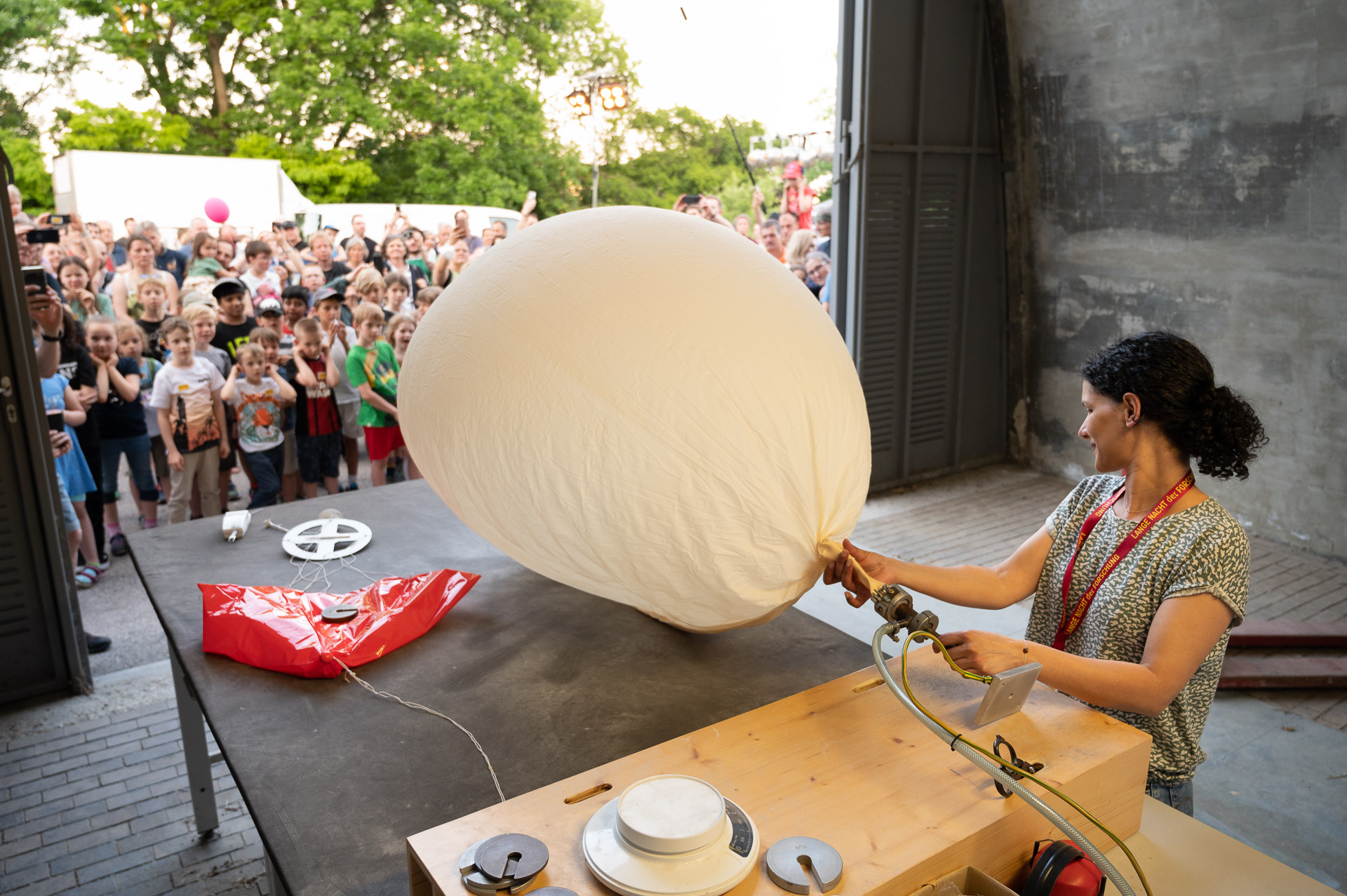
Radiosondenaufstieg_LNF_01.jpg
Launch of the radiosonde during the Long Night of Research at the Hohe Warte in Vienna. © Daniel Auer
“We’re not the only ones tracking the trajectory,” emphasises GeoSphere Austria technician Philemon Löffelmann. He and his colleagues work in shifts to fill the balloons with hydrogen – and to ensure they ascend successfully. Two radiosondes from different manufacturers are used: one weighs around 30 grams, the other around 100 grams. The former does not need a parachute, but the latter certainly does. This is because, in the best-case scenario, the balloons reach the stratosphere and burst there. The radiosondes return to Earth – where they are already awaited by ‘sonde hunters’.
“Probe hunters” are a great help to GeoSphere Austria. They organise themselves and exchange information via, amongst other things, the website SQ6KXY Radiosonde Tracker — Meteorological Probe Database. The weather balloons, located via radio, are closely tracked whilst in flight, and their “crash site” is precisely documented. “You can register via the website to collect a radiosonde. This makes sense because otherwise several people might drive to the same location and then be disappointed,” explains Philemon Löffelmann. The sondes – consisting of a polystyrene casing, sensors and electronics – are normally handed in to GeoSphere Austria. “This way, we can reuse up to 70 per cent of the radiosondes that are found,” says Löffelmann happily.
Weather balloons are launched all over the world, always at the same time. Punctuality is paramount here, as the data from the radiosondes is used to create weather models. Their altitude and flight path suggest that GeoSphere Austria’s balloons do not necessarily ‘land’ in Austria. But the amateur radio operators are very well connected, says Löffelmann: ‘We’ve even received 100 Hungarian sondes.’
Translated with DeepL.com (free version)