
The grass pollen season has begun
Around a quarter of Austrians suffer from allergies. Food, animals, house dust mites – and many other triggers. However, pollen accounts for by far the largest proportion. Grass flowers traditionally begin to bloom in early May. As the so-called sweet grasses form a huge family, the flowering season extends into September. GeoSphere Austria and MedUni Vienna are working closely together to provide the public with the best possible information.
Meadow foxtail and sweet vernal grass are considered harbingers and effectively herald the start of the grass pollen season. Meadow bluegrass has also begun to flower. ‘This means the grass pollen season is starting,’ explains Katharina Bastl from the Vienna Pollen Service at MedUni Vienna. Together with her husband Maximilian, she tracks pollen levels, particularly in the capital. Common oatgrass, orchard grass – what most people pass by without a second thought is of the utmost interest to the couple. This is because the pollen trap on the roof of the Institute of Forensic Medicine on the MedUni Vienna campus in the 9th district, where all manner of material otherwise accumulates from which the necessary conclusions can be drawn, is of no use when it comes to identifying grass species. ‘Grass pollen grains cannot be distinguished under the microscope,’ says Maximilian Bastl.
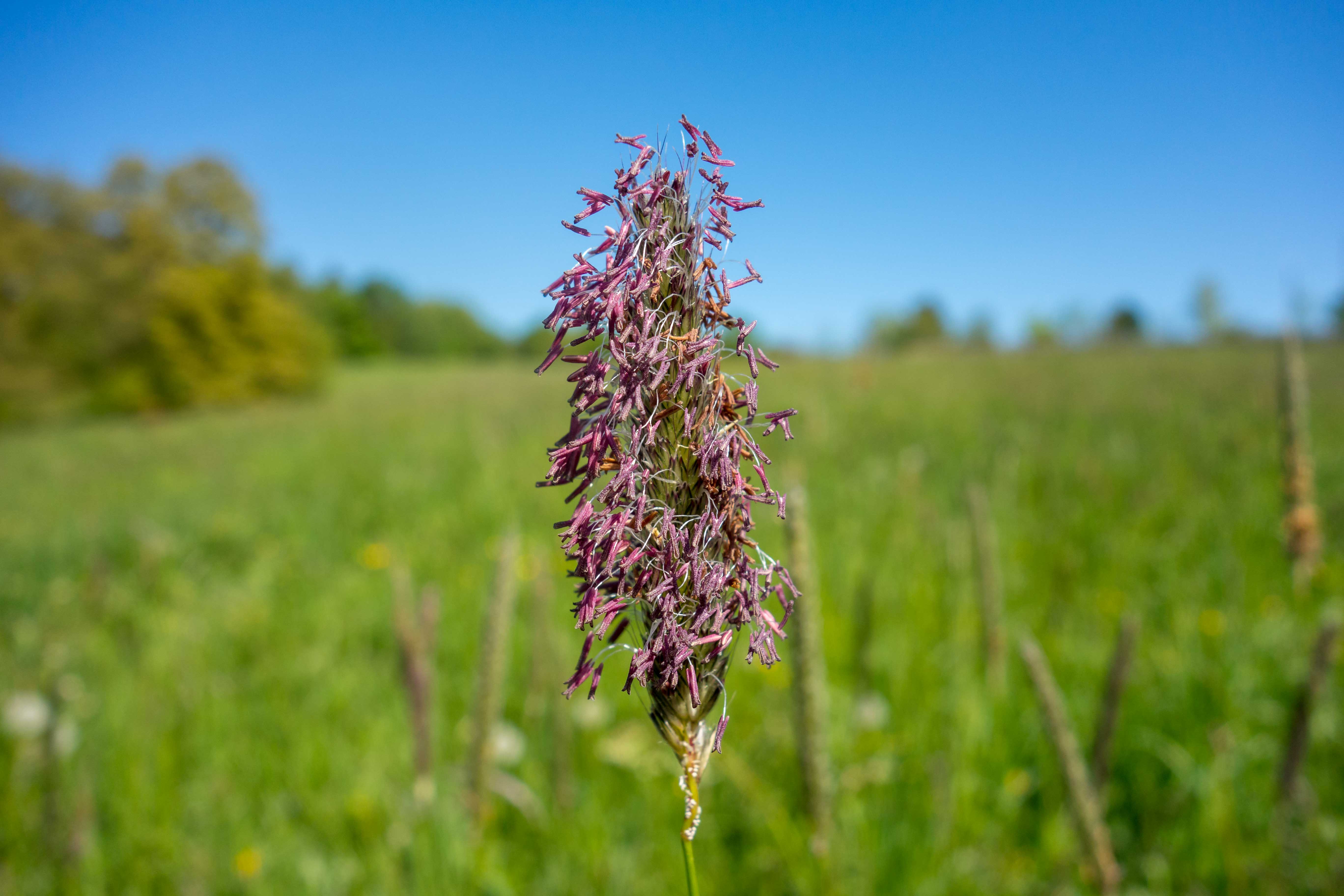
Meadow_foxtail.jpg
Meadow foxtail. © Katharina Bastl/MedUni Wien/Pollenservice Wien.
That is why MedUni Vienna works closely with GeoSphere Austria. They specialise in phenology there. The term is derived from the ancient Greek word phaíno, which means ‘I appear’. It concerns seasonal developments in the animal and plant world: when do phenomena such as bud burst, flowering, fruit ripening and leaf fall occur, or even the first cockchafer of the year?
The researchers are relying on the public to help. Whether via the phenowatch.at website or the Nature Calendar app, people can share their observations and records, thereby making a significant contribution to completing the overall phenological picture. In the Nature Calendar app, you can filter by different plant species. For example, you can see whether observations of flowering of orcahrd grass have already been reported in the region. Thanks to the collaboration between GeoSphere Austria and Pollenservice Wien, further plants relevant to allergy sufferers were added to the app last year. ‘These observations can therefore be helpful for people with pollen allergies,’ emphasises climatologist Kerstin Haslehner from GeoSphere Austria. ‘To document current developments in the plant and animal world, we need phenological observations from all over Austria. With the Nature Calendar app, anyone can easily help out. We welcome everyone who takes part.’
The oldest phenological observations in the GeoSphere Austria dataset date back to 1851. For the start of flowering of orchard grass – a species of relevance from an allergological perspective – there are documented observations dating from 1943 onwards. This time series of observations makes it possible to investigate the shift in the start of flowering of the orchard grass due to climate change. From 1961 to 1990, the flowering of the common bent grass began, on average across Austria, two weeks later than in the period from 1991 to 2020.
A time-consuming phase is now also beginning for Katharina and Maximilian Bastl. For in addition to analysing the pollen traps, it is now increasingly a case of ‘getting out and looking’. This has nothing to do with relaxing walks in woods and meadows, as nothing should escape the expert eye. Utmost concentration is required. It is not only native species that pose a problem for allergy sufferers. ‘Introduced’, i.e. invasive species such as dog’s tooth grass and red millet have also joined the fray. ‘Ornamental grasses are also often planted in urban areas,’ adds Maximilian Bastl. The flowering of ornamental grasses is a particular issue in summer, thereby prolonging the season for all those with grass pollen allergies.
Once summer is over and autumn sets in, the reeds begin to flower. This is a particular issue in the Seewinkel region around Lake Neusiedl, but also along the Danube. “Grass pollen is not affected by climate change: the total pollen count tends to remain stable,” adds Katharina Bastl. And a further note for all those who spend the summer months in the mountains: there, the grass pollen season begins around a month later, coinciding with the holiday season.
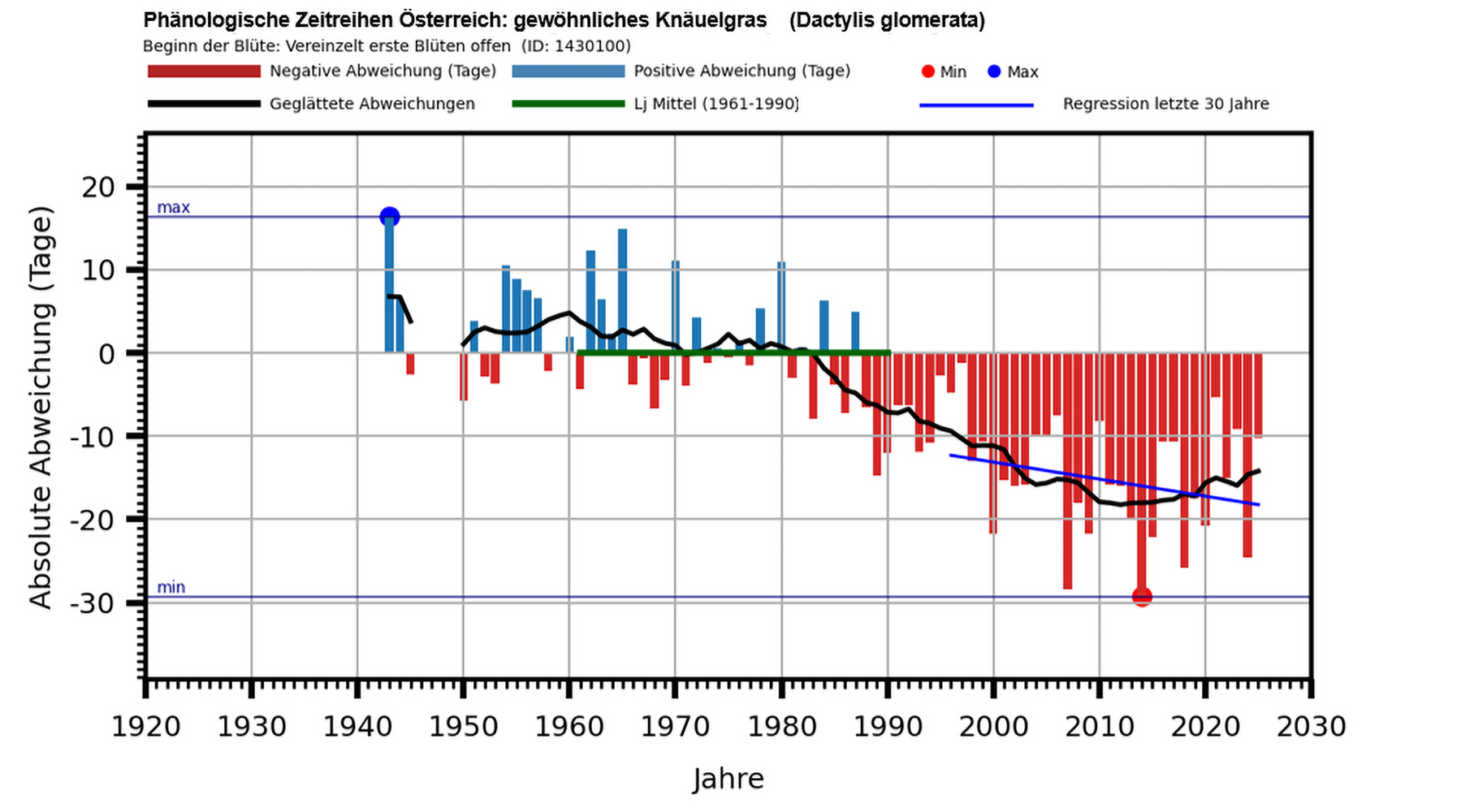
phenological_time_series_bent_grass.png
Phenological time series of the onset of flowering of orchard grass in Austria. The Austrian observations were reduced and averaged using multiple regression to a single station with the fictitious coordinates 15°E, 48°N and 200 m. Blue bars indicate a later onset date, red bars an earlier one. © GeoSphere Austria.
Translated with DeepL.com (free version)