
Very dry December
Preliminary monthly summary from GeoSphere Austria: One of the 15 driest Decembers in recorded history. In the mountains, it was the second warmest December in recorded history and very sunny. In the lowlands, it was very cloudy in places due to persistent fog, with isolated records for the longest period without sunshine.
December 2025 brought many high-pressure weather systems and thus often the inversion weather typical for winter: mild and almost cloudless in the mountains, relatively cool and often foggy and cloudy in the lowlands. These differences are clearly reflected in the preliminary December summary.
‘Taking into account the forecast for the end of the month, December 2025 ranks second in the series of warmest Decembers in the 175-year mountain measurement series. In the lowlands, December was significantly less extreme, ranking 46th in the 259-year lowland measurement history,’ says climatologist Alexander Orlik from GeoSphere Austria.
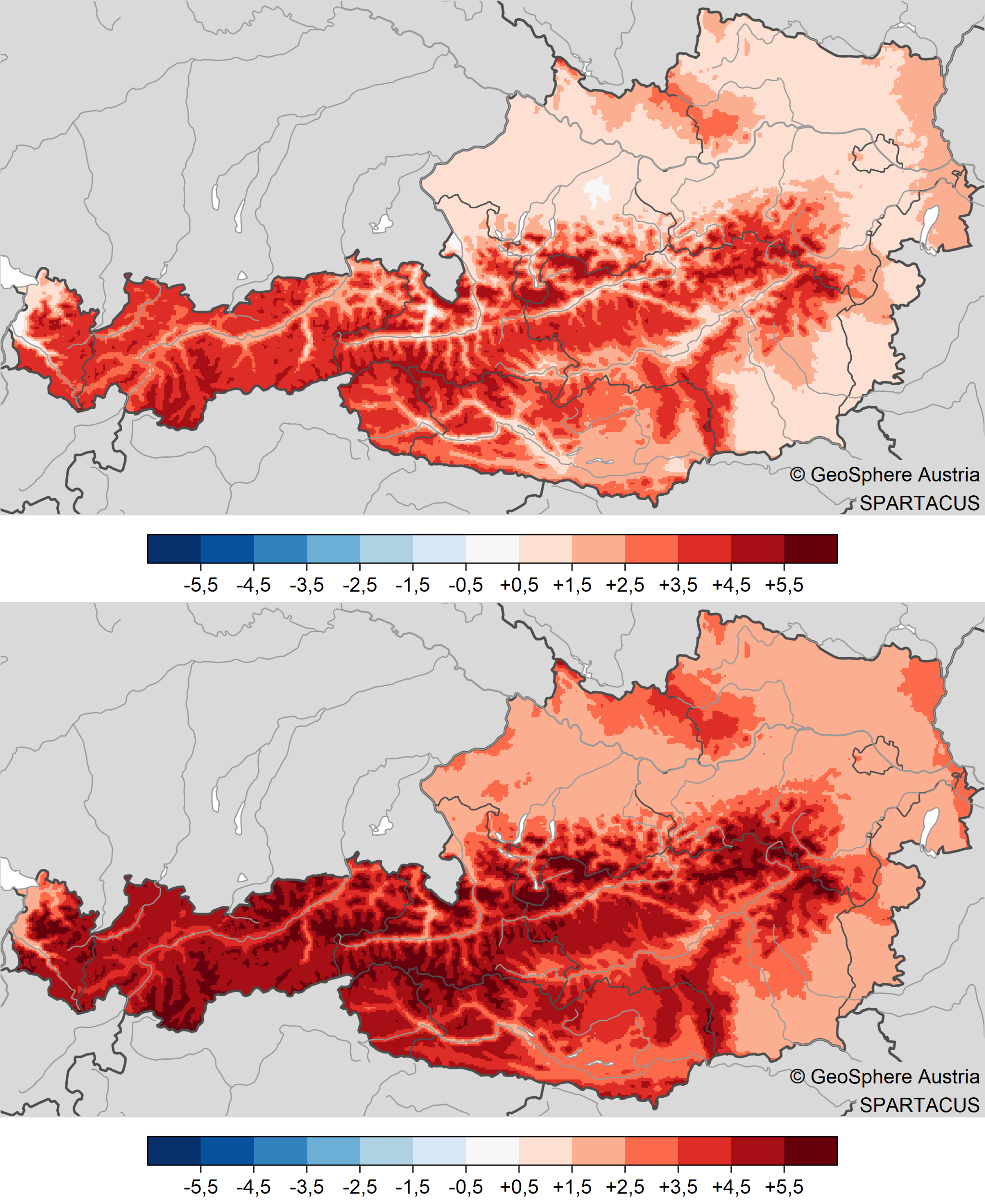
In the preliminary monthly balance, December 2025 in the lowlands of Austria was 0.9 °C above the average December in the recent past (climate period 1991-2020), and in the mountains it was 3.6 °C too warm.
Compared to the climate period from 1961 to 1990, December 2025 was 2.0 °C above average in the lowlands of Austria and 4.5 °C above average in the mountains.
December-2025_Temp.png
Temperature in December 2025: deviation of temperature from the mean. Bottom image compared to the 1961–1990 mean, top image compared to the 1991–2020 mean. Analysis using SPARTACUS data up to and including 29 December 2025. © GeoSphere Austria.
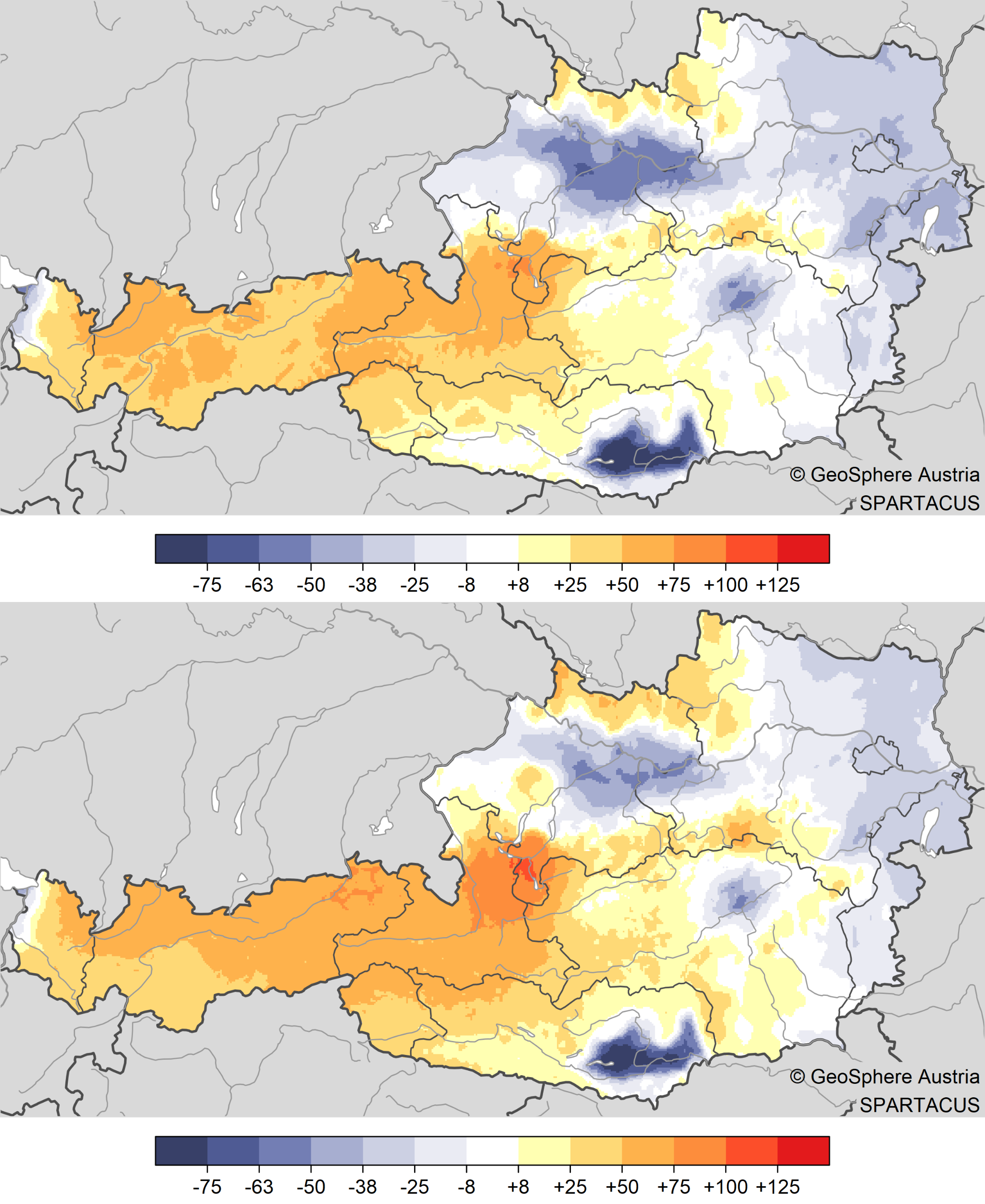
The number of hours of sunshine in December 2025 varied greatly: it was very sunny in the mountains, especially in the western half of Austria. Here, GeoSphere Austria recorded 30 to 100 per cent more hours of sunshine than in an average December. In many low-lying areas, however, there was frequent fog or high fog, resulting in 50 to 80 per cent fewer hours of sunshine than in an average December in some places, for example in Vienna, Burgenland, the lowlands of Lower Austria and Upper Austria, the Klagenfurt Basin and the Lavant Valley, as well as the Rhine Valley.
In some cases, the number of hours of sunshine was even close to record lows. For example, the fewest hours of sunshine in December in the history of the Klagenfurt Airport weather station were 11 in December 1932 and 2020 and 13 in December 1903. In December 2025, there were only 8 hours of sunshine in Klagenfurt until 29 December. A final balance will only be possible after the end of the month.
In some regions, December 2025 brought new records for the longest period without sunshine:
For example, the sky above the Linz Hörsching weather station was grey for 23 days, from 29 November to 21 December. The previous record here was 16 days without sunshine in January 2020.
The Klagenfurt Airport weather station has been continuously grey since 9 December and currently (as of 30 December) has already had 21 days without sunshine. The previous record here was 18 days in the winter of 1973/74.
In Eisenstadt, December 2025 brought the third-longest series without sunshine, with 14 days (from 12 to 25 December). The only times it has been cloudier here were in 1995 with 26 days and 1985 with 17 days.
December-2025_Sun.png
Sunshine duration in December 2025: deviation of sunshine duration: image below compared to the 1961-1990 average, image above compared to the 1991-2020 average. Evaluation with SPARTACUS data up to and including 29 December 2025. © GeoSphere Austria.
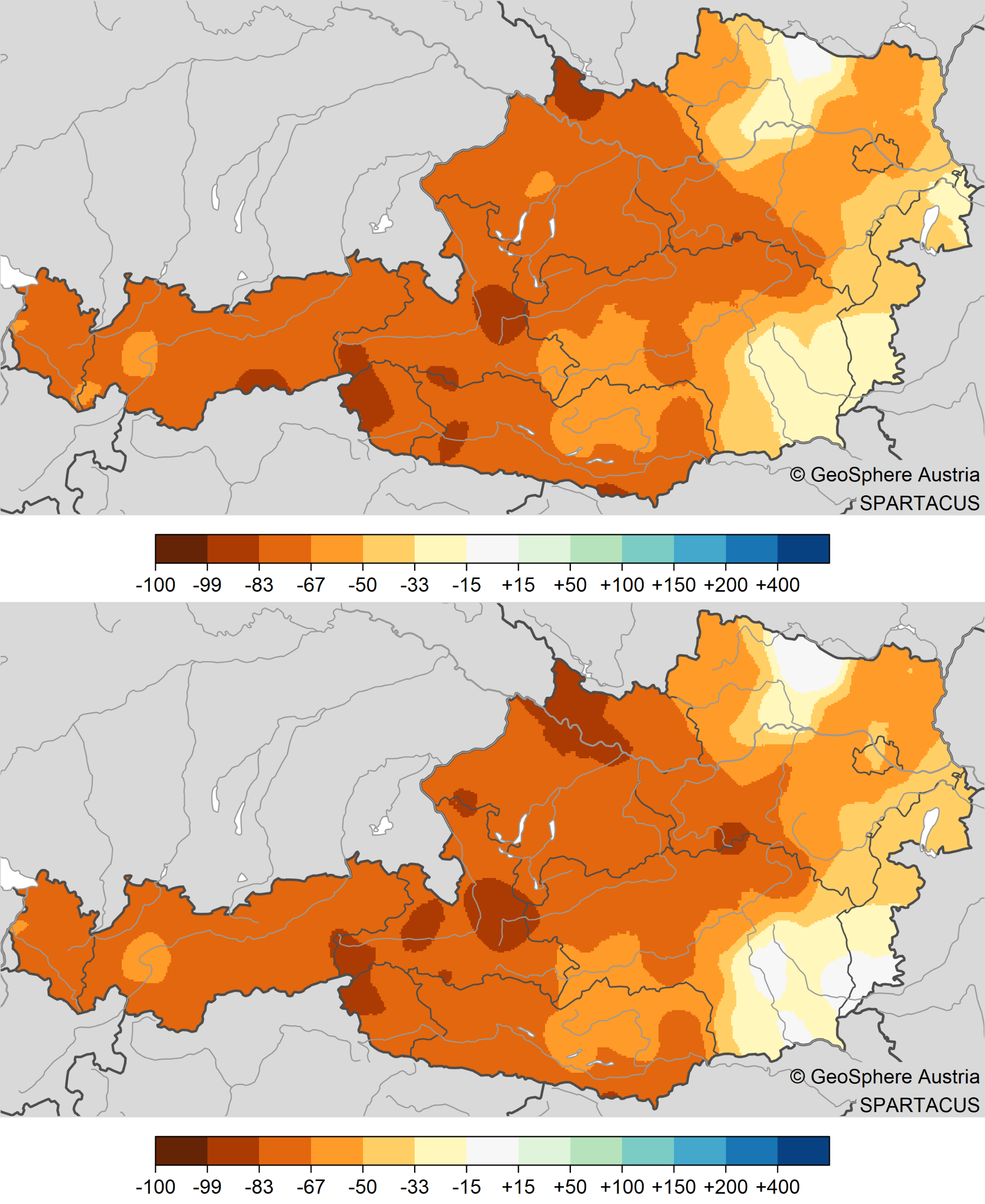
The many high-pressure weather systems also made for an extremely dry December. In the Austria-wide evaluation, 60 per cent less precipitation fell in December 2025 than the long-term average. This makes it one of the 15 driest Decembers in recorded history.
The last time there was similarly little precipitation in December was in 2016 (-66 per cent). The last time it was significantly drier in December was in 2015 (-76 per cent).
December-2025_precipitation.png
Precipitation in December 2025: deviation of precipitation from the average: image below compared to the average for 1961-1990, image above compared to the average for 1991-2020. Evaluation with SPARTACUS data up to and including 29 December 2025. © GeoSphere Austria.
Due to the dry and, in mountainous regions, very mild weather, December 2025 saw relatively few days with snow cover (days with a snow cover of at least one centimetre at at least 50 per cent of the observation sites) at all altitudes:
Below 500 metres above sea level, there were 75 per cent fewer days with snow cover than in an average December across Austria. The range here was quite large, between -100 per cent in Eisenstadt and -8 per cent in Krems.
At altitudes of 500 to 1,000 metres above sea level, there were 68 per cent fewer days with snow cover on average across Austria than the long-term average.
Above 1,000 metres above sea level, there were large regional differences, with a range from three per cent fewer days with snow cover (e.g. in St. Jakob/Defereggen in East Tyrol) to 80 per cent fewer days with snow cover (e.g. in Fischbach in Styria).
Translated with DeepL.com (free version)