
White or green Christmas?
An analysis by GeoSphere Austria shows that white Christmases have become significantly less common in the low-lying areas of Austria, but occur with reasonable reliability at higher altitudes.
Global warming is also affecting snow conditions at Christmas in Austria.
“Of course, there are significant fluctuations from year to year, but in the long term, the average December in Austria has become about two degrees warmer over the last 50 years,” says climatologist Alexander Orlik from GeoSphere Austria. “As a result, snow is becoming increasingly rare at Christmas in low-lying areas. Instead of snowflakes, December now often brings raindrops, and any snow that does fall melts away more quickly than it used to. A white Christmas is reasonably reliable in Austria at altitudes of around 800 meters above sea level. Even here, the climate has become milder in recent decades, but it is still often cold enough for snowfall.”
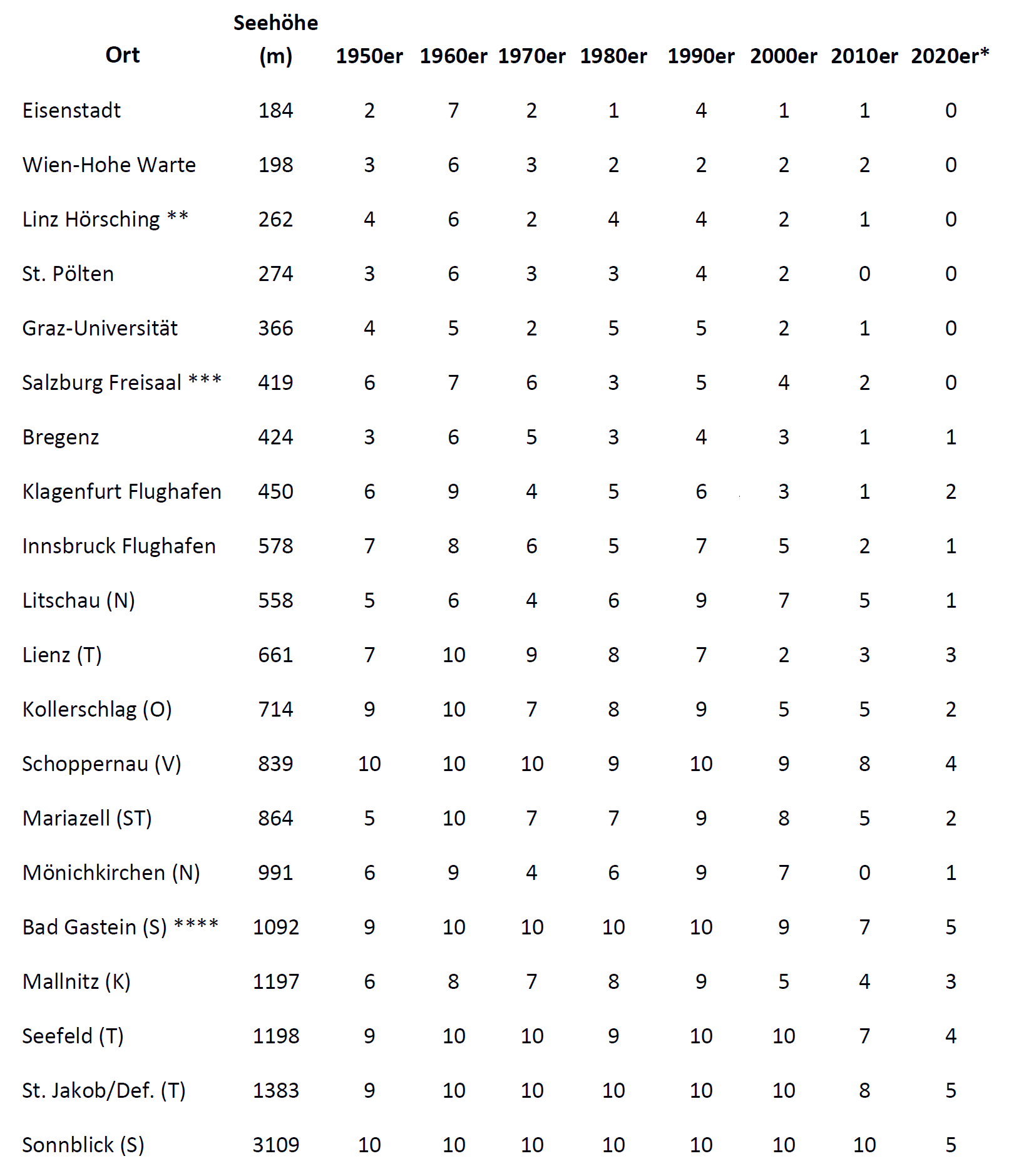
In response to the question “How often was there a snow cover of at least one centimeter on December 24?”, an evaluation by GeoSphere Austria shows that snow at Christmas has become increasingly rare in the low-lying areas of Austria, especially since the 1960s.
For example, at the Vienna Hohe Warte weather station, there was snow on December 24 three times in the 1950s, six times in the 1960s, and three times in the 1970s. In the 1980s, 1990s, 2000s, and 2010s, there was snow on December 24 twice at the Hohe Warte in Vienna. So far in the 2020s, there has never been snow here on December 24.
At higher altitudes, however, white Christmases are still quite reliable. In Schoppernau in Vorarlberg, for example, at 839 meters above sea level, there has been snow on December 24 almost every year since 1950. Only in 1985, 2002, 2014, 2016, and 2022 did Schoppernau experience a green Christmas.
The following table shows the figures for state capitals and some locations at higher altitudes.
TabelleWeihnachten.png
How often was there snow on December 24 in each decade? (at least 1 cm of snow at 50 percent of the observation sites © GeoSphere Austria
Notes on the table: * 2020s up to and including 2024, ** from 2022 Linz city, *** up to 1986 Salzburg Airport, **** from 2020 Bad Hofgastein.
The last few years have brought a very long period of green Christmases to many low-lying areas of Austria. Fourteen years ago, in 2010, snow fell on December 24 in most of the provincial capitals (Bregenz, Salzburg, Linz, Vienna, Graz, Klagenfurt).
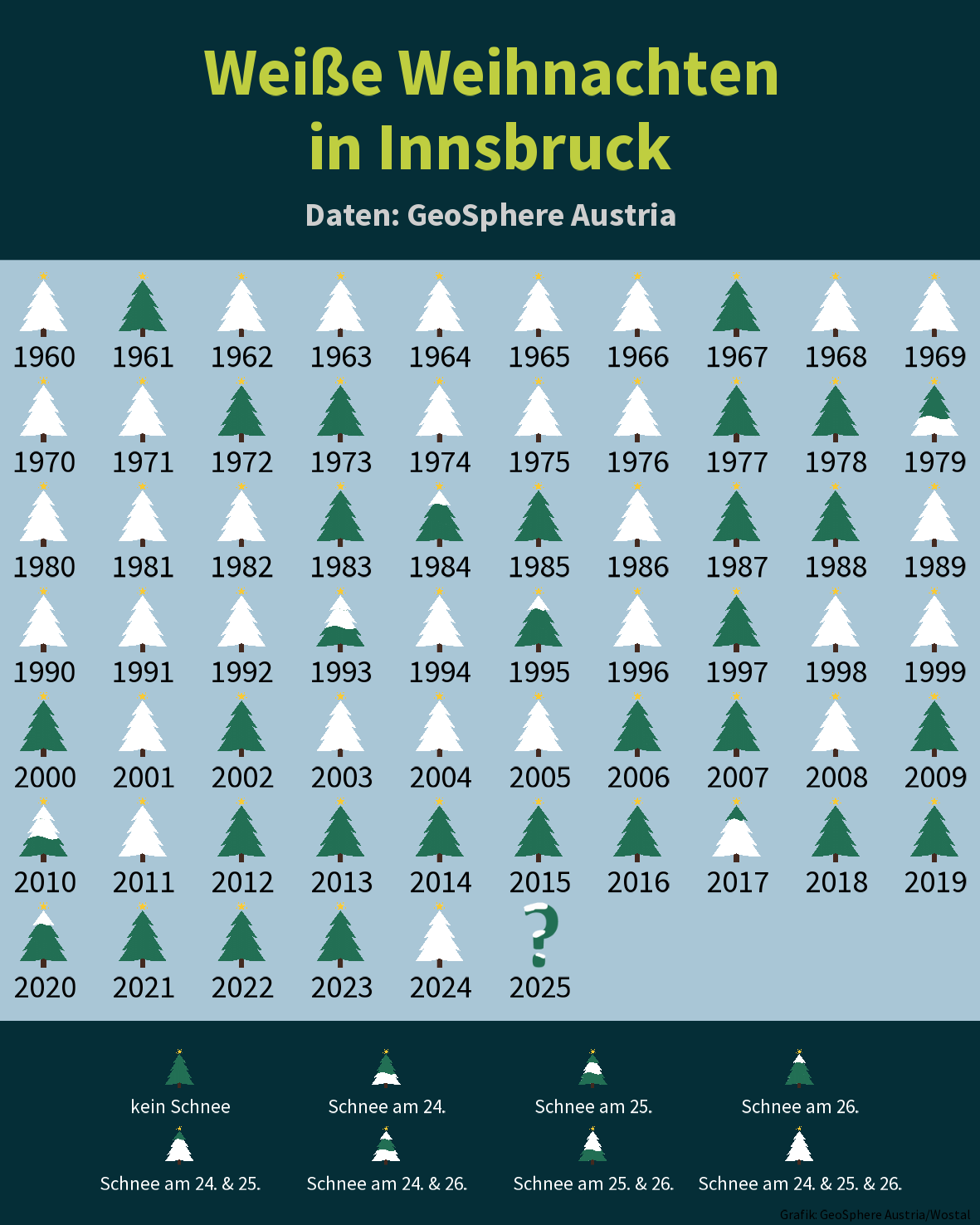
Since 2010, it has rarely been white on December 24 in the provincial capitals, as was the case in 2011 in Innsbruck and Salzburg, 2012 in Vienna and Eisenstadt, 2017 in Innsbruck, 2021 in Klagenfurt, and 2024 in Bregenz, Innsbruck, and Klagenfurt..
(Anmerkung: „Schneedecke“ ist hier definiert als mindestens 1 Zentimeter Schneehöhe an mehr als 50 Prozent des Beobachtungsortes um 7 Uhr.)
If you are looking for Christmas snow records, you have to go back a long way in the data series. On December 24, 1962, there was 96 centimeters of snow at the Innsbruck Airport weather station. There was 55 centimeters at Graz Airport on December 25, 1994, 50 centimeters in St. Pölten on December 24, 1969, 47 centimeters in Klagenfurt on December 24, 1994, 35 centimeters in Salzburg on December 24, 1962, 39 centimeters in Eisenstadt on December 24, 1969, 47 centimeters in Vienna Mariabrunn on December 24, 1969, 26 centimeters in Bregenz on December 26, 1981, and in Linz (airport), the record snow depth is 25 centimeters on December 25, 1969.
The coldest temperatures on record are also far behind us. According to an Austria-wide evaluation of all GeoSphere Austria weather stations below 1,400 meters above sea level, the coldest temperature on record was -29.0 degrees Celsius in Tamsweg (S) on the night of December 26, 1944. 1962 was also extreme. At that time, the maximum (!) temperature on December 25 in Vils (Tyrol, Reutte district) was -19.8 °C. In Kitzbühel, it was -27.9 °C on the night of December 24 to 25, 1962.
The Salzburg Airport weather station holds the Christmas heat record for all of Austria with 19.1 °C on December 25, 2013.
There are still two weeks until Christmas. Therefore, it is not possible to make a meaningful weather forecast for the holidays at this time.
One thing is certain: no significant amounts of new snow are expected until the beginning of next week. In addition, the next few days will bring very mild weather, with temperatures above freezing even in the high mountains.
Weihnachten Innsbruck.png
White and green Christmases from 1960 to 2024. © GeoSphere Austria/Wostal.
Translated with DeepL.com (free version)