
Alarming acceleration: Global glacier melt continues to advance
Global glacier melt continued at a high level during the 2025 hydrological year. Excluding the two major ice sheets of Greenland and Antarctica, glaciers worldwide recorded a net mass loss of 408 (± 132 gigatonnes). This corresponds to a contribution to global sea-level rise of 1.1 (± 0.4 mm) within a single year. GeoSphere Austria makes a significant contribution to the global database through the continuous monitoring of five reference glaciers in the Alps and Greenland. The latest results have now been published in the journal Nature Reviews Earth & Environment and in the European State of the Climate Report 2025.
The figures highlight an alarming acceleration: whilst the loss between 1976 and 1995 was still below 100 gigatonnes per year, it has almost quadrupled over the past decade (2016 to 2025) to an average of 390 gigatonnes per year. Six of the years with the greatest losses in recorded history have occurred in the past seven years. Michael Zemp, Director of the World Glacier Monitoring Service (WGMS) and lead author of the study, draws a vivid comparison: ‘The annual mass loss of glaciers in 2025 would have filled five Olympic-sized swimming pools every single second of the year.’
The new analysis is based on a complex combination of direct field measurements and global modelling. Bernhard Hynek, a glaciologist at GeoSphere Austria and co-author of the study, explains the methodological approach: ‘What makes this analysis so scientifically robust is the assimilation of extensive in-situ measurement data from reference glaciers worldwide. These locally collected data were extrapolated to the total global ice area using geostatistical methods. Only by linking precise direct measurement data with regional climate models and remote sensing data is it possible to significantly reduce the uncertainties in mass balance calculations and produce a representative picture of global glacier variations.’
Every year, mass changes are directly measured at around 150 glaciers worldwide; these data serve as a reference for global models. GeoSphere Austria contributes to five of these monitoring programmes: at the Pasterze (Austria’s largest glacier), at three smaller glaciers in the vicinity of the Sonnblick Observatory, and at the Freya Glacier in north-east Greenland. ‘The Freya Glacier plays a particularly important role in international glacier monitoring, as there is very little direct measurement data from Greenland due to its remoteness: whilst over 40 glaciers are surveyed annually in the Alps, there are only five across the whole of Greenland,’ says Hynek.
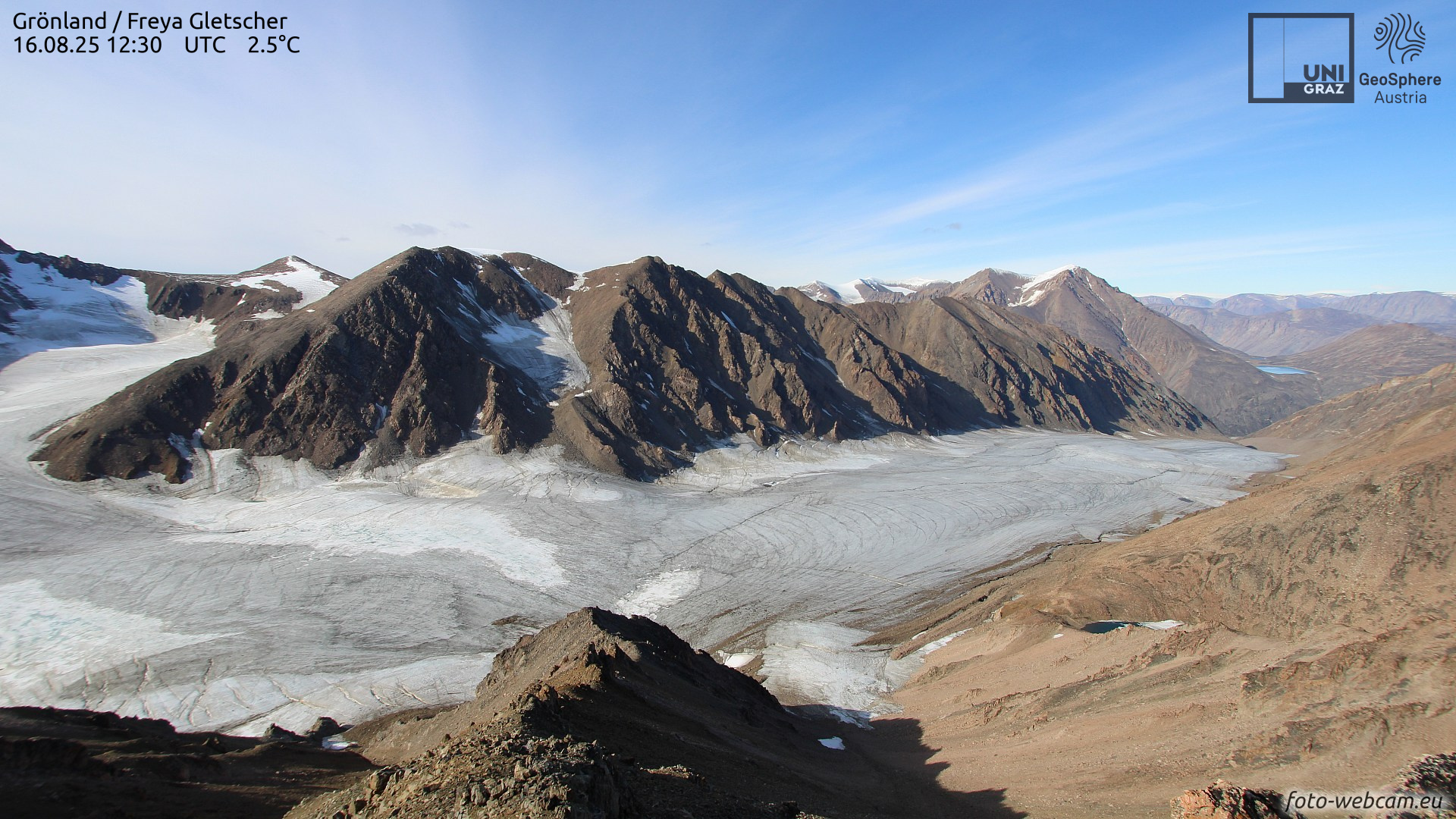
Greenland_Freya-Glacier.jpg
The Freya Glacier in August 2025, captured by the GeoSphere webcam. © foto-webcam.eu.
A comparison highlights the scale of the problem of glacier melt. Anton Neureiter, also a glacier expert at GeoSphere Austria and co-author of the study: ‘Whilst the Pasterze in the Alps lost over one and a half metres of ice thickness in 2025, the Freya Glacier in the colder Arctic lost only about half a metre. However, the decisive factor for sea level is area: due to their enormous extent, Arctic glaciers transport far greater volumes of water into the oceans than the small Alpine ice fields, despite their slower melting rate.’
Last year, the area-specific melt rate was highest in western Canada and the USA, in Iceland, and in Central Europe. However, in 2025, the largest regional contributions to global mass loss in terms of volume came from the extensively glaciated regions of the High Himalayas, Alaska and the Russian Arctic.
Glaciers and ice sheets In climate research, a distinction is made between mountain glaciers and the two massive ice sheets in Greenland and Antarctica:
- Mountain glaciers (‘early warning systems’): These react immediately to climatic changes. Their remaining melt potential is around 32 to 41 cm of sea-level equivalent. Measurements are usually carried out by national programmes with teams of experts on site.
- Ice sheets (‘sleeping giants’): Greenland and Antarctica lost around 250 Gt of mass in 2025. The trend here is clearly on the rise, particularly in Greenland and West Antarctica. Complete melting would correspond to a sea-level rise of over 65 metres. Monitoring is primarily carried out through international satellite missions and complex modelling.
Facts & Figures (hydrological year 2025):
- Mass loss from mountain glaciers: 408 Gt (equivalent to a 1.1 mm rise in sea level).
- Mass loss from ice sheets (Greenland/Antarctica): approx. 250 Gt.
- Contribution by GeoSphere Austria: 5 out of approx. 150 global reference measurement series.
- GSA reference glaciers: Freya Glacier (Greenland), Pasterze, Kleinfleißkees, Goldbergkees, Wurtenkees (Hohe Tauern).
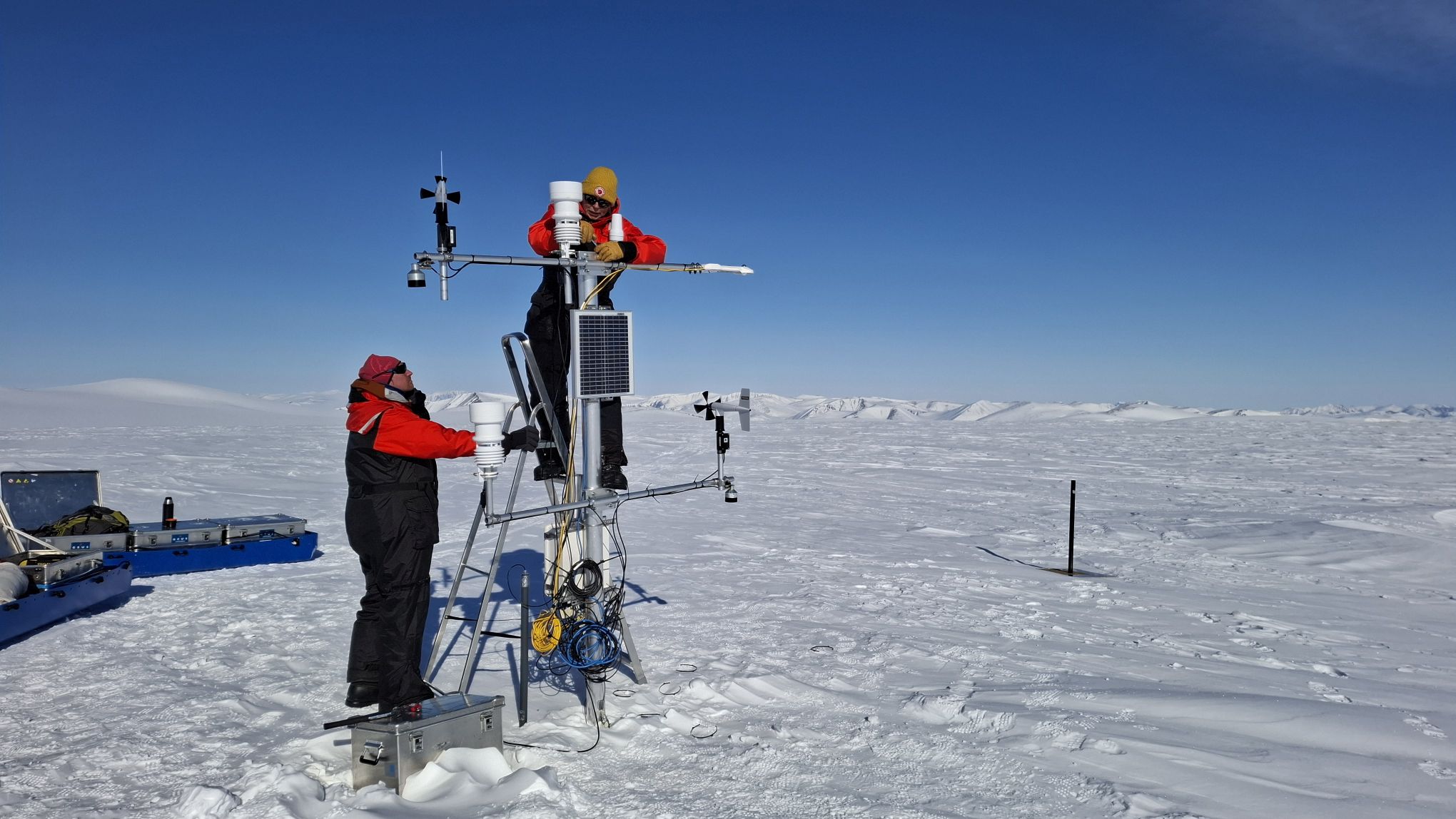
Greenland_Weather-station.jpg
Work on an automatic mass balance measuring station on a glacier in Greenland. © GeoSphere Austria.
Translated with DeepL.com (free version)