
Aurora borealis over Austria due to strong geomagnetic storm
The Space Weather Office of GeoSphere Austria reports the highest field strength in the solar wind near Earth in 31 years.
On the night of Tuesday (20 January 2026), a strong solar storm hit the Earth's magnetic field and caused impressive aurora borealis in many regions around the world, including Austria. No problems with satellites, navigation systems or power grids have been reported so far. However, disruptions to satellite-based navigation systems in particular cannot be completely ruled out. The geomagnetic storm is also expected to cause increased radiation levels for astronauts and flights on polar routes.
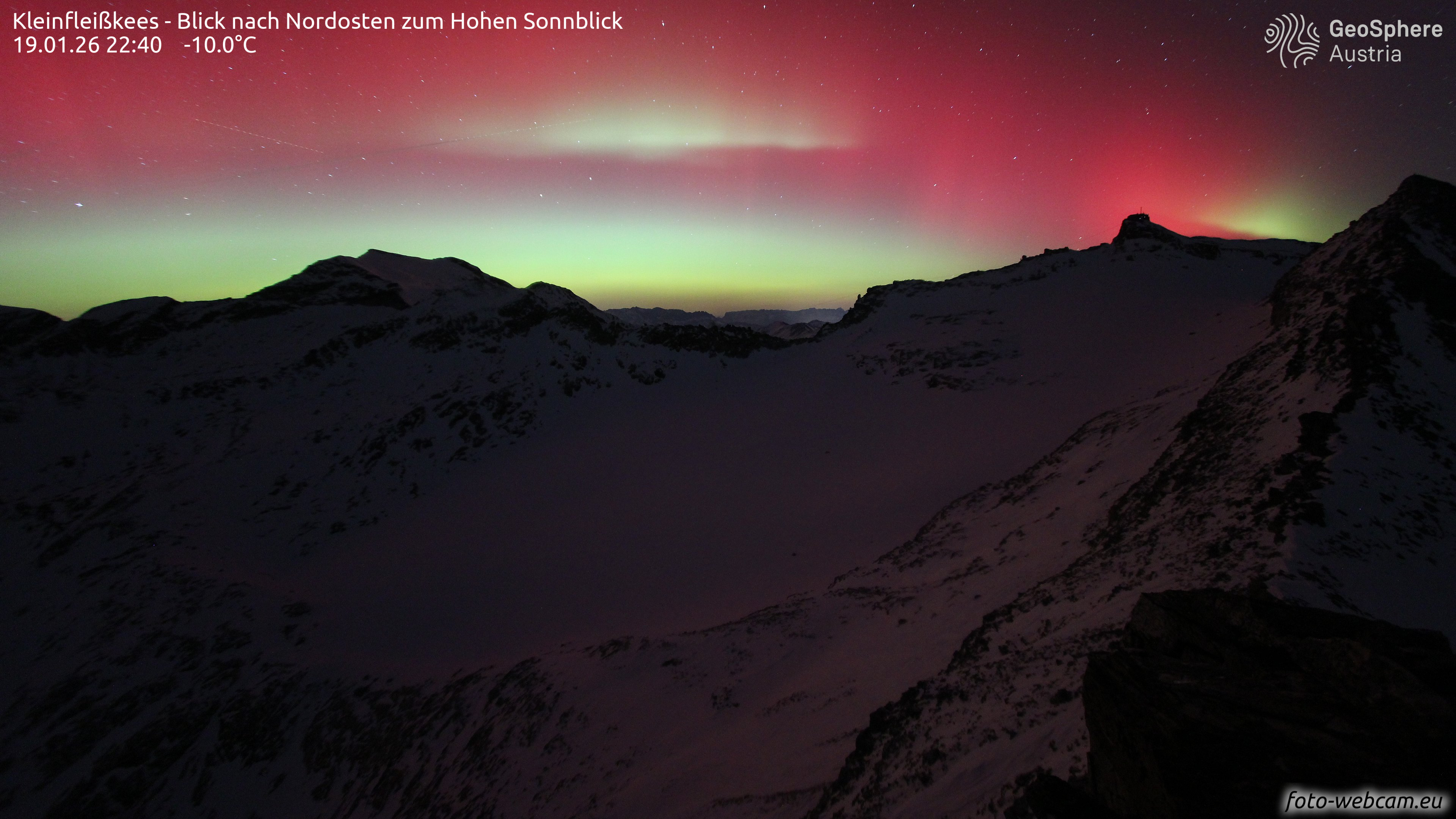
Autora borealis_19-01-2026.jpg
Aurora borealis over Austria. Taken on the night of 20 January 2026 in the Sonnblick region of the Hohe Tauern mountains. © www.foto-webcam.eu.
‘The current solar storm reached an exceptionally high field strength of 91 nano-Tesla near Earth, which is ten times the average value. There have never been comparable measurements in our records, which began in 1995. This is the strongest value recorded in at least 31 years,’ says Christian Möstl, head of the Space Weather Office at GeoSphere Austria.
With a speed of around 1,178 kilometres per second (4.2 million kilometres per hour), it was also the fastest solar storm of the current solar cycle to hit Earth.
‘It is remarkable that this exceptionally strong solar storm did not trigger the strongest geomagnetic storm of the current solar cycle, but nevertheless one of the four strongest aurora nights,’ explains Möstl. ‘The reason for this lies in the alignment of the magnetic field inside the storm: it was directed almost exactly northwards and thus unfavourably oriented to couple efficiently with the Earth's magnetic field. If the orientation had been the opposite, it is very likely that the strongest geomagnetic storm since 1989, possibly even since 1921, could have occurred. In such a scenario, large-scale power outages might also have been possible. However, a precise assessment requires further simulations.’
The Solar Orbiter spacecraft from the European Space Agency (ESA) once again provided valuable information on the development of the solar storm and enabled an accurate prediction several hours in advance. The storm had already passed the probe at a distance of around 110 million kilometres. This meant that the magnetic field structure of the event was known at an early stage.
The event impressively underlines the importance of upstream monitoring. GeoSphere Austria's Space Weather Office is one of the leading international research groups in this field. The aim is to process valuable information from space probes as early as possible in the forecasting systems in order to assess the nature of the approaching solar storm and its possible effects on Earth.
The reason for the relatively large number of auroras since 2024 lies in natural fluctuations in the sun. ‘We are currently at the maximum of the so-called 11-year solar cycle. In this phase, the sun forms more magnetic fields, which are visible as sunspots. This phase will continue into 2026. From 2027 onwards, it will weaken again until the next cycle begins in the early 2030s, ’ explains Christian Möstl from the Space Weather Office at GeoSphere Austria.
The sun constantly emits radiation and charged particles into space. During a solar flare (solar storm), the sun ejects a large amount of particles within a short period of time, together with strong magnetic fields. When a solar storm hits the Earth's magnetic field, it can cause auroras and, in extreme cases, disrupt satellites, navigation systems and power grids.
In order to provide timely warnings of such events, the Space Weather Office at GeoSphere Austria in Graz is working on innovative methods for real-time prediction of solar storms and is now one of the world's leading organisations in this field.
Translated with DeepL.com (free version)