
GeoSphere Austria at OSCA Perspectives in Vienna
As a member of the Open Scientific Collections Austria (OSCA) consortium, the Palaeontology and Collections Unit of GeoSphere Austria participated in the workshop ‘OSCA Perspectives: From Institutional Commitment towards National and European Infrastructures’, held on 11–12 September 2025 at the Natural History Museum Vienna.
Over two days, inspiring presentations shed light on both the opportunities and challenges of digitization in scientific collections. Together with Federal Minister Eva-Maria Holzleitner of the Federal Ministry for Women, Science and Research (BMFWF), we celebrated the important milestone of OSCA joining DiSSCo (Distributed System of Scientific Collections), a European research infrastructure initiative. Through OSCA, Austria is now part of this Europe-wide network, and GeoSphere Austria is proud to contribute its extensive palaeontological collections to the digital transformation of natural science heritage.
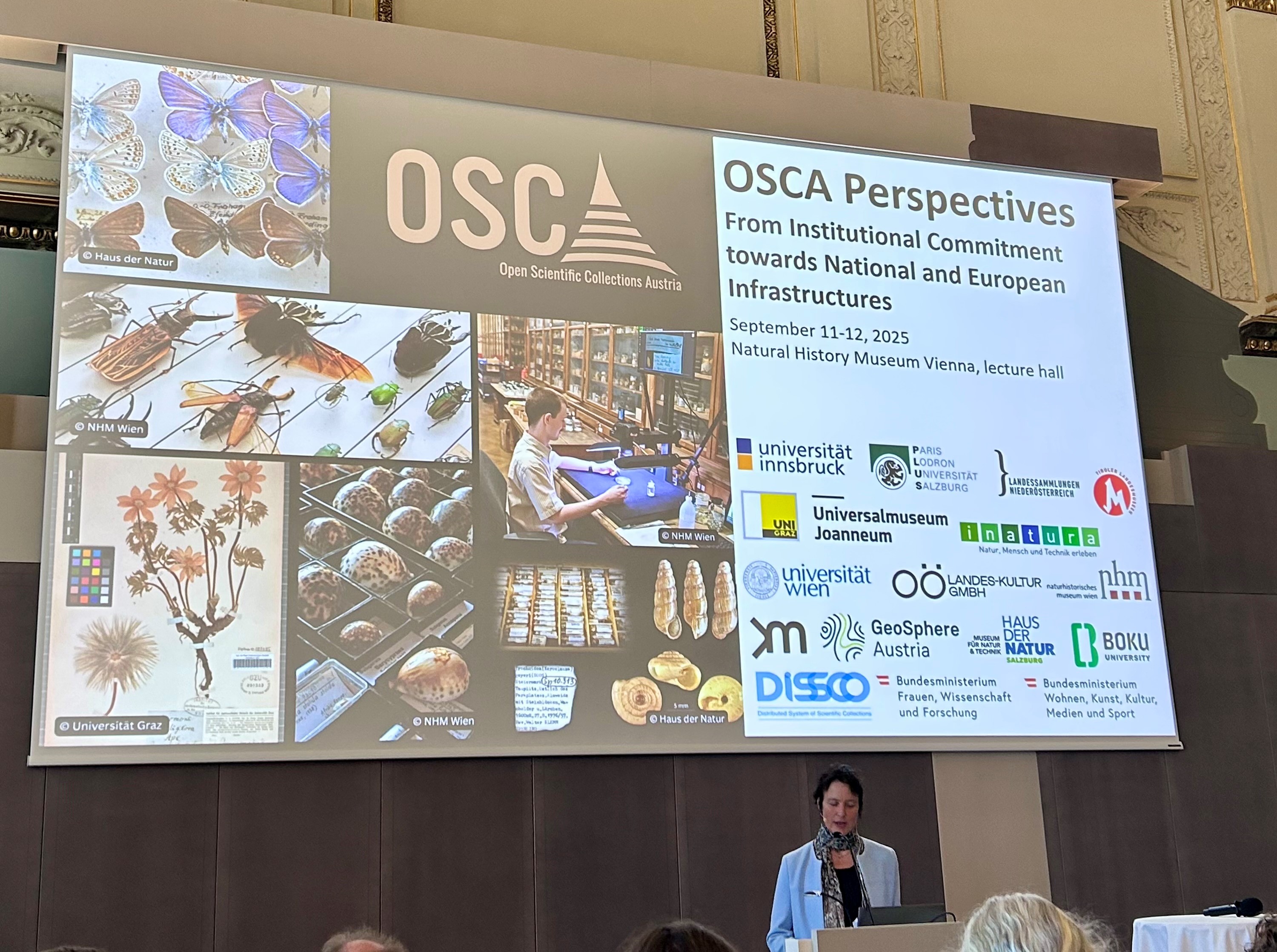
OSCA worshop.jpg
Opening of the OSCA Perspective workshop. © GeoSphere Austria/Festi.
During the workshop, the GeoSphere team worked closely with partner institutions to develop methods and concepts for data harmonization, further strengthening cooperation within Austria and across Europe. The shared goal is to build a comprehensive digital inventory of Austrian collections, encompassing biological (botanical and zoological), earth science (palaeontological, geological, mineralogical, extraterrestrial), and anthropological specimens.
Digitizing and standardizing collections is crucial: it makes scientific knowledge widely accessible, preserves fragile specimens, and allows researchers to explore collections from anywhere in the world—creating new opportunities for research, education, and innovation.
The workshop underscored Austria’s central role in the digitization of natural science collections and highlighted its active contribution to DiSSCo, the largest European network of natural history museums, botanical gardens, universities, and other research institutions.