
March 2026 – spring-like warmth, little rainfall, particularly sunny in the north and east
Preliminary March summary from GeoSphere Austria: In the lowlands, it was the 22nd warmest March in 260 years of recorded history. There was hardly any rainfall, particularly in eastern Austria.
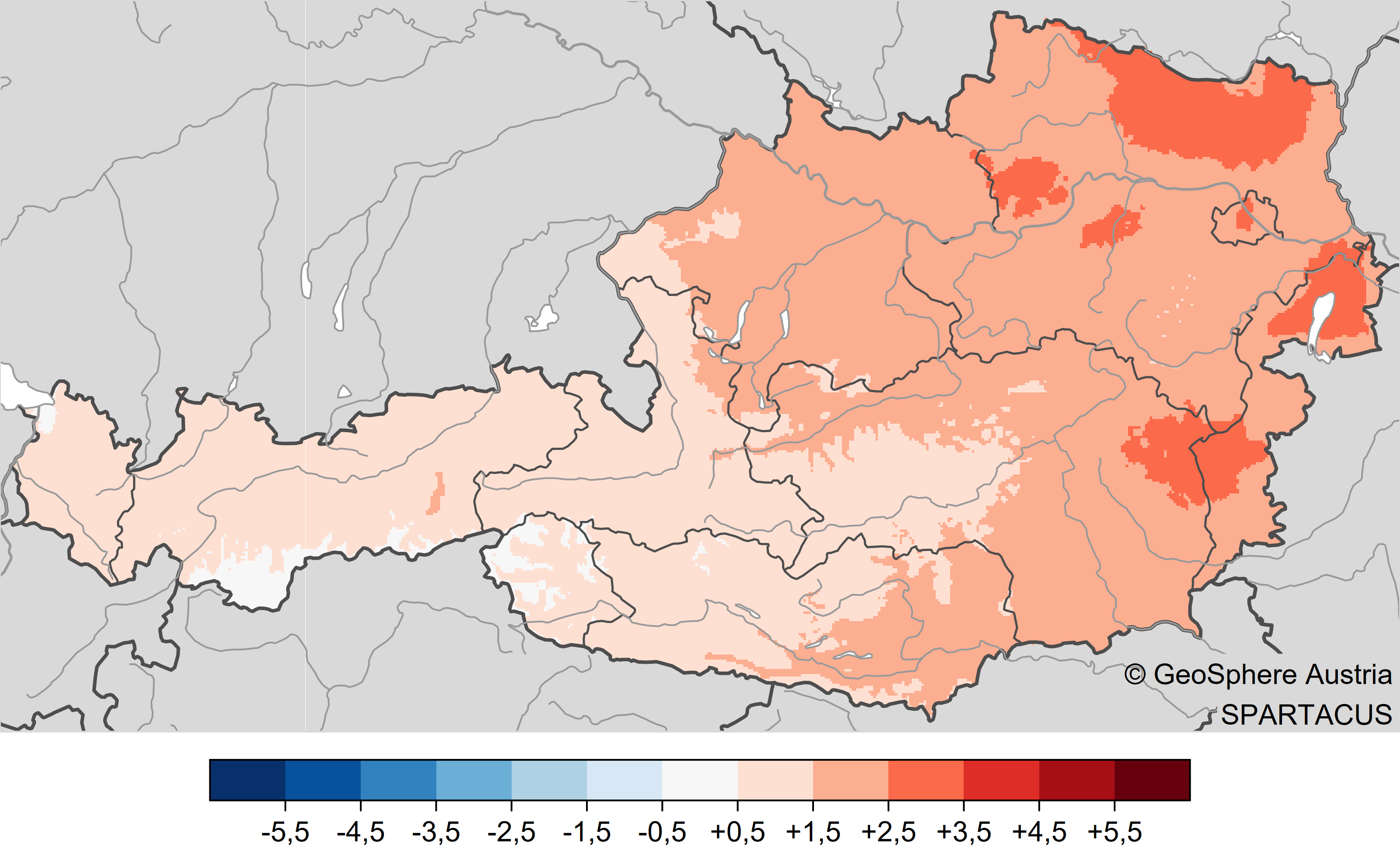
March was above-average in terms of warmth, particularly in the mountains and in the south and west of the country. ‘Despite the prolonged period of high pressure with little cloud cover – which is actually prone to night-time frosts – there was relatively little frost, especially below 1,000 metres above sea level,‘ explains climatologist Alexander Orlik from GeoSphere Austria. March 2026 was 1.2 degrees Celsius warmer in the lowlands than the average for the 1991–2020 reference period and 2.5 degrees warmer than the 1961–1990 climate average. This placed it 22nd among the warmest March months in Austria’s 260-year history of weather records. In the mountains, with a temperature deviation of 0.7 and 2.0 degrees respectively, it was the 36th warmest March since 1851.
The highest air temperature of 20.4 degrees was recorded at the Innsbruck University measuring station on 7 March. The lowest temperature below 1,000 metres above sea level was recorded on 28 March in Ehrwald (Tyrol, 982 m) at minus 13.7 degrees. On the same day, it was minus 15 degrees in Lech (V, 1,442 m).
March_2026_Temp.png
Temperature in March 2026: deviation of temperature from the average compared to the average for 1991–2020. Evaluation using SPARTACUS data up to and including 30 March 2026. © GeoSphere Austria.
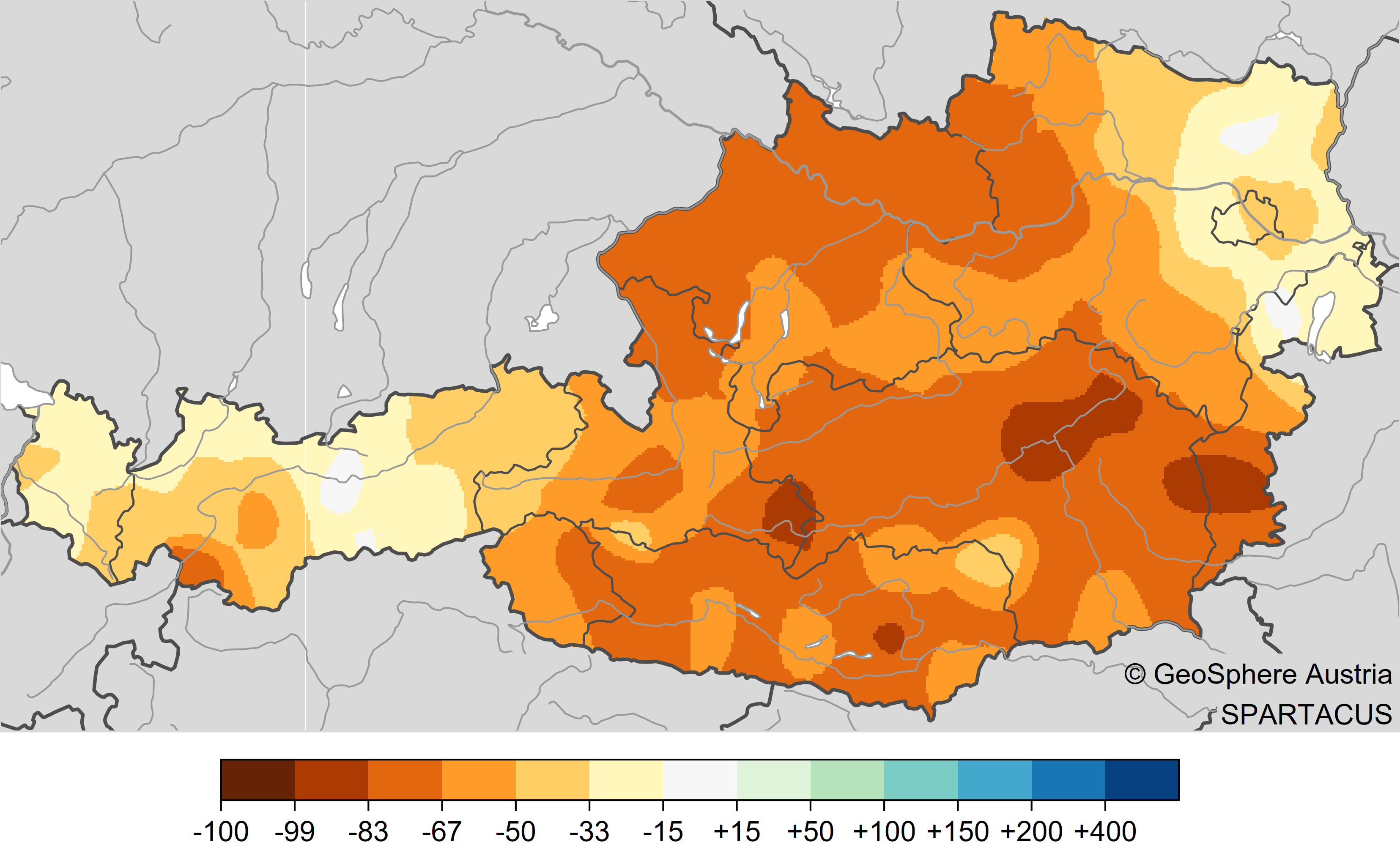
March 2026 was significantly too dry in many parts of Austria. The regions with the largest negative deviations from the climate average in March 2026 were the eastern half of Salzburg, Upper Austria, the western Waldviertel, Styria, southern Burgenland and parts of Lower Carinthia. Precipitation in these areas was between two-thirds and four-fifths lower than average. Hartberg (ST) and Wörterberg (B) were the driest places in Austria in March 2026, with two millimetres of precipitation each and deviations from the average of 93 and 94 per cent respectively.
March_2026_precipitation .png
Precipitation in March 2026: deviation of precipitation from the average compared to the 1991-2020 average. Evaluation with SPARTACUS data up to and including 30 March 2026. © GeoSphere Austria.
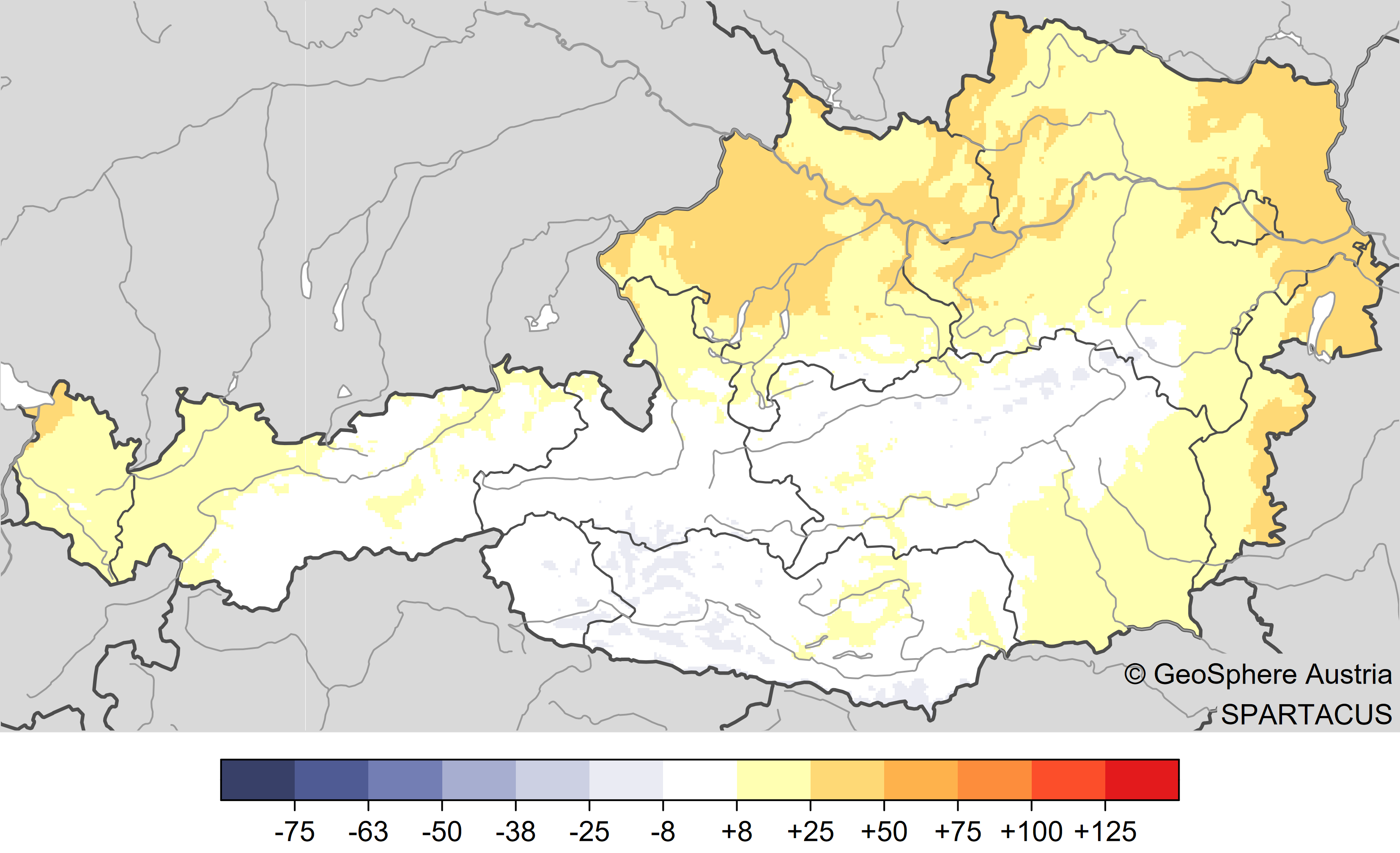
March was split in two in terms of hours of sunshine. There were plenty in the first half of the month, but far fewer in the second. The sunniest locations, each with 207 hours of sunshine, were Podersdorf (B, 116 m) and the Brunnenkogel (T, 3437 m). In Litschau (N, 558 m), 158 hours of sunshine were recorded – 29 per cent more than the long-term average for 1991–2020.
March_2026_sun.png
Sunshine duration in March 2026: deviation of sunshine duration compared to the 1991-2020 average. Evaluation using SPARTACUS data up to and including 30 March 2026. © GeoSphere Austria.
The willow began to flower six days before the average start of flowering for the period 1991 to 2020. The start of flowering for forsythia and apricot trees was also early, beginning ten days earlier than the average for 1991 to 2020. In addition, the first observations were already made regarding the start of flowering of sweet cherry, as well as the emergence of foliage on larch and horse chestnut.
Translated with DeepL.com (free version)