
October 2025 relatively dry, cool and cloudy
Preliminary October summary from GeoSphere Austria: 25 per cent less precipitation than the long-term average and 17 per cent fewer hours of sunshine. Around 0.3 degrees cooler in the lowlands and 1.5 degrees cooler in the mountains than the average for the climate period from 1991 to 2020.
‘October 2025 brought mainly weather conditions from the west to the northeast and calm high-pressure weather. Days with mild southerly flows were rare and rainy low-pressure areas only grazed Austria. Therefore, it was a relatively dry, cool and cloudy October overall,’ says climatologist Alexander Orlik from GeoSphere Austria.
According to preliminary monthly figures, October 2025 was 0.3 degrees below the average for the 1991 to 2020 climate period in the lowlands of Austria and 1.5 degrees below average in the mountains.
This puts October 2025 in 94th place in the list of warmest Octobers in Austria's 259-year measurement history in the lowlands and in 109th place in the 175-year mountain measurement series. Compared to the 1961–1990 climate period, October 2025 was 0.4 degrees above average in the lowlands and 1.3 degrees below average in the mountains.
‘After the three extremely warm October months of 2022, 2023 and 2024, it was the coolest October in Austria's lowlands since 2021. In the mountains, it was even the coolest October since 2016,’ says climatologist Orlik.
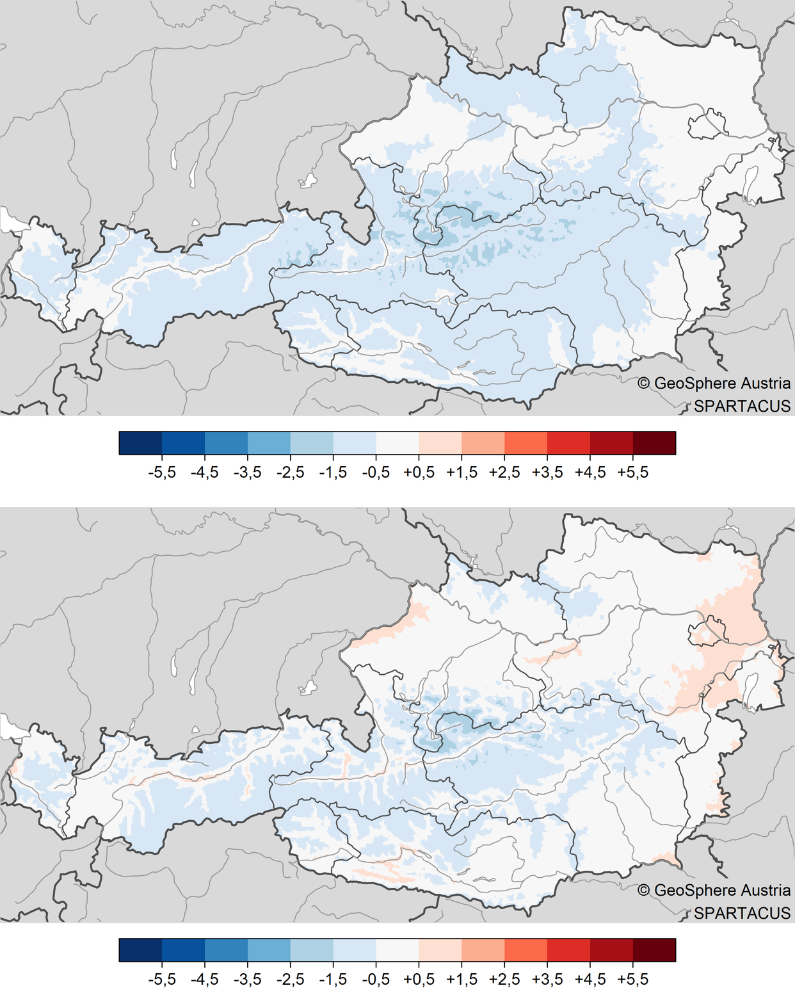
temperature_october_2025.png
Temperature in October 2025: deviation of temperature from the mean. Bottom image compared to the 1961–1990 mean, top image compared to the 1991–2020 mean. Analysis using SPARTACUS data up to and including 30 October 2025. © GeoSphere Austria.
In the Austria-wide evaluation, October 2025 brought 25 percent less precipitation than the long-term average.
In some places, there was 40 to 75 percent less precipitation, especially in some regions of the Tyrolean Alps, East Tyrol, Carinthia and Styria. Two examples: In Lienz in East Tyrol, 33 millimetres of rain fell this October, compared to an average of 105 millimetres in October. In Zeltweg in Styria, there was 27 millimetres of rain this October, compared to a long-term average of 67 millimetres.
October 2025 brought average to slightly above-average precipitation in the area from the Kitzbühel Alps across most of Salzburg and Upper Austria to the Mostviertel region and in the north of Upper Styria.
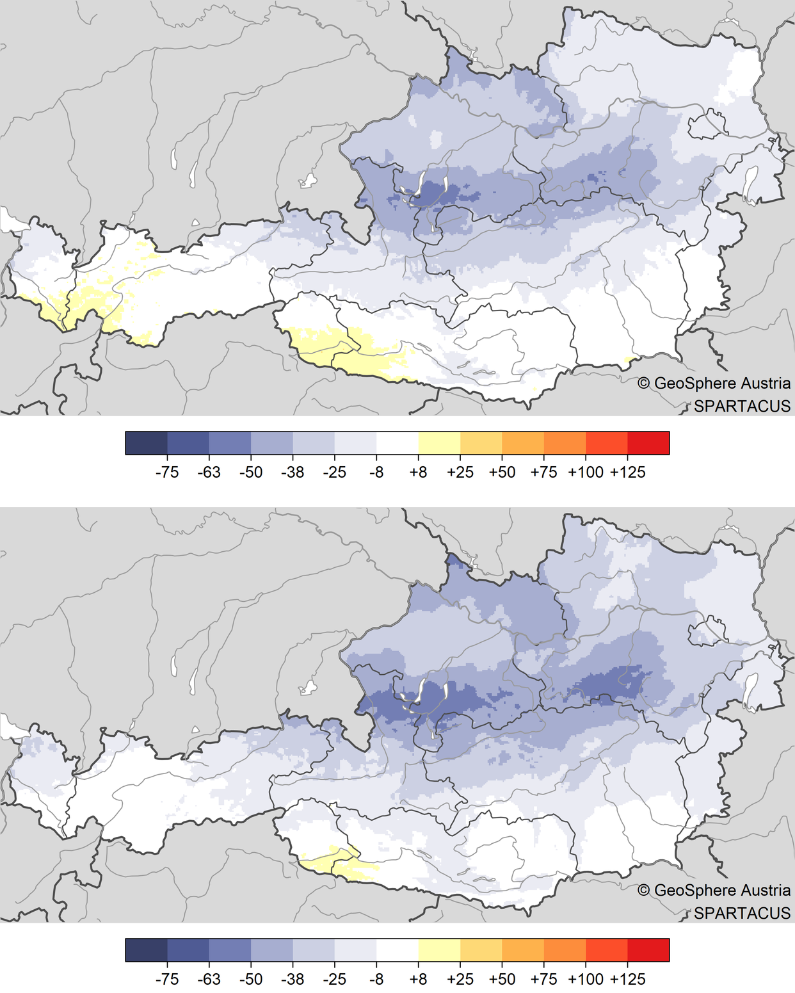
sunshine_october_2025.png
Sunshine duration in October 2025: Deviation in sunshine duration: bottom image compared to the 1961–1990 average, top image compared to the 1991–2020 average. Analysis using SPARTACUS data up to and including 30 October 2025 © GeoSphere Austria.
In recent weeks, higher mountain passes experienced their first taste of winter weather this autumn. Snow also fell briefly in some valleys. On the morning of 28 October, for example, there were three centimetres of snow in Ramsau am Dachstein, at 1,207 metres above sea level. There were isolated snowflakes up to around 900 metres. ‘Such winter weather is typical for mid- to late October and occurs about once every one to two years,’ explains climatologist Alexander Orlik from GeoSphere Austria.
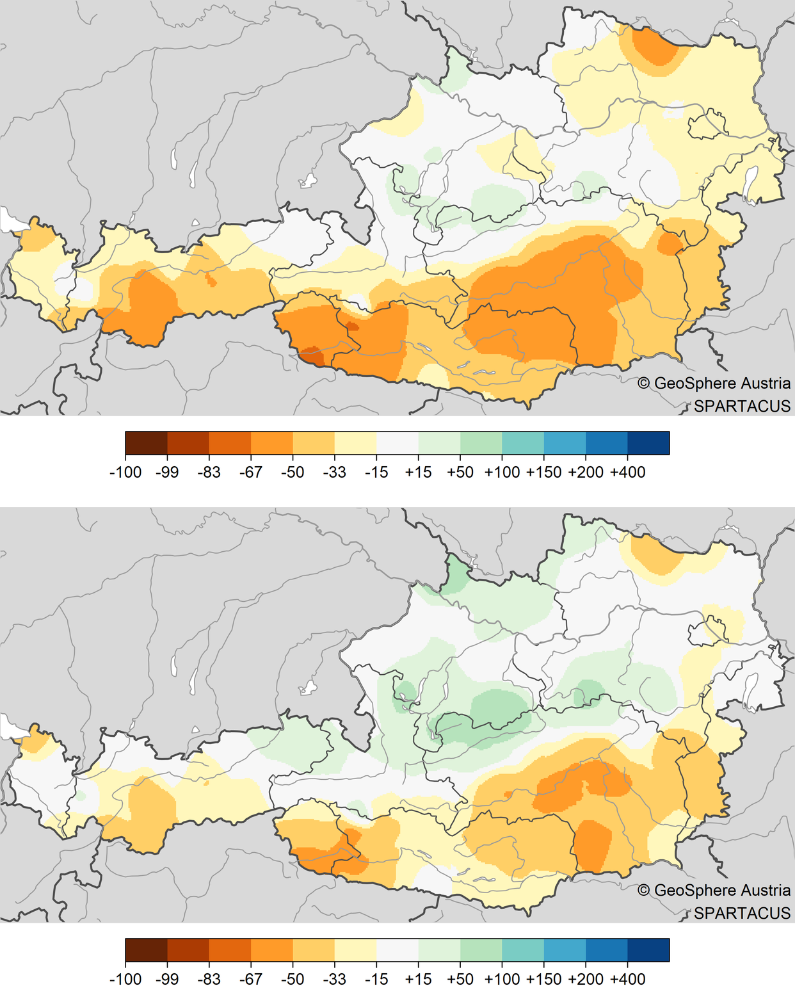
precipitation_october_2025.png
Precipitation in October 2025: deviation of precipitation from the mean: bottom image compared to the 1961–1990 mean, top image compared to the 1991–2020 mean. Evaluation
with SPARTACUS data up to and including 30 October 2025. © GeoSphere Austria.
The number of hours of sunshine in October 2025 was 17 per cent below average for October across Austria. This made it the gloomiest October since 2020.
The mostly subdued temperatures in October 2025 brought a rather average start to the leaf colour change of many tree species, such as European beech and apple. Grapevines, English oak, small-leaved lime, large-leaved lime, sweet cherry and hazel also changed colour, and spindle trees began to ripen.
For example, the average leaf colour change for European beech (50 per cent of leaves changed colour) across Austria was on 15 October 2025, two days behind the long-term average for 1991-2020 and six days behind the average for 1961-1990.
The average date of leaf colour change for apple trees across Austria was 12 October 2025, three days earlier than the long-term average for 1991-2020 and one day behind the average for 1961-1990.